Varieté and Revue – A Search for Traces in Paris and Leipzig
Much has been written and reflected upon regarding the origins of the circus, its various forms, and definitions. Interestingly, this ubiquitous discussion about identity plays hardly any role in the world of Varieté. Perhaps this is because the 250th anniversary of the modern circus, celebrated a few years ago, sparked considerable historical interest. Perhaps it is also because variety shows already embody diversity in their very name, and one doesn’t expect a consistent aesthetic development or clear distinction from related genres.
That it can nevertheless be worthwhile to delve into the roots of this art form is demonstrated by Urs Jäckle, the artistic director of the Leipzig Krystallpalast Varieté Theatre, with his current show production, “Rouge – Eine Varieté-Revue.” Varieté and revue – two forms of entertainment art that share a common origin – converge here. And Urs Jäckle deliberately sets this encounter in Paris. Not only because it evokes associations with legendary names like the Moulin Rouge, the Lido, or the Crazy Horse, but also because it brings the historical circle full circle. For it was in 19th-century Paris that the term “revue” was first used in connection with public entertainment performances. Thus, this article is not intended to be a typical show review, but rather to provide insight into the revue and its connections to vaudeville, using the origins of “Rouge” as a case study.
From the 1830s onward, Parisian popular theaters presented year-end revues. These were “plays with hidden chambers in which the author presented all the more or less important events of the past year to the audience,” as Romain Piana describes them in his book “La revue théâtrale de fin d’année en France au XIXe siècle” [1]. In a time before mass media, the revue therefore had not only an entertaining but also an informative function. Using popular songs and dramatic devices, she guided the audience through the year’s important events—a form of “edutainment,” as we would probably call it today.
Revues were performed in 19th-century Paris in the same venues where vaudeville originated, such as the legendary Folies Bergère. At the beginning of the 20th century, theaters shifted their focus. Programs featuring soloists touring with independent acts are considered “Varieté”, while revue theaters emphasized large-scale, concept-driven productions in which the individual performers mostly remained anonymous.
Even then, Paris was a cultural metropolis, and various stages vied for the audience’s favor with increasingly spectacular stage effects, ever more magnificent costumes, and ever larger casts. This penchant for extravagance would later become a defining characteristic of the revue. “When you talk to revue producers in Paris, what distinguishes a good revue is an absolute spectacle of elaborate sets and materials,” says Urs Jäckle, based on his studies. The Friedrichstadt-Palast in Berlin, with its world’s largest theater stage and its emphasis on ever more expensive and elaborate productions, is another example.
Urs Jäckle, with the small stage and intimate atmosphere of the Krystallpalast, naturally couldn’t take its cue from this. “If you rely so heavily on effect as a stylistic device, then you commit yourself to constantly outdoing yourself throughout the evening,” he explains. This approach didn’t interest him. At the same time, he refers to the Crazy Horse in Paris as an example of alternative revue styles. There, all the elements of a revue are present, in a very small space and with a clear artistic profile. Founded in 1951 by Alain Bernardin, the theater emphasizes another aspect that is considered an ingredient of a revue – eroticism. It is known for its very revealing dancers, selected according to uniform physical criteria, who are presented in an avant-garde style, for example, with sophisticated lighting effects.
The body as an art object and – in this case, quite literally – a projection surface for art – this brings us to the next characteristic of the revue. As Urs Jäckle emphasizes, revues were used early on as a laboratory for extravagant fashion. In terms of nudity, a variety theater like the Krytallpalast naturally has different boundaries than the Paris nightclub scene, to which the Crazy Horse belongs. In Leipzig, the focus is less on the artful undressing and more on the artful dressing. “For Rouge, we chose a high-fashion approach, where we work very experimentally,” explains Urs Jäckle. “The understanding of costume goes much further; it’s about more than just putting on something beautiful.” He draws parallels with the Bauhaus movement, with Oskar Schlemmer, and with the understanding of the body as a stage.

While a certain degree of frivolity is an integral part of revue, the erotic portrayal of the female body, especially in today’s world, carries the risk of falling into clichés and reproducing traditional gender stereotypes. It’s essential to offer counterpoints and do justice to diversity, particularly in urban environments – revue is a big-city phenomenon (perhaps with the exception of the Royal Palace in the tranquil town of Kirrwiller). Drag star Conchita Wurst has performed at the Crazy Horse – and in Leipzig, Jonathan and Ben Finch-Brown bring a progressive edge with their fusion of aerial acrobatics and queer boylesque.
Time to mention the two arguably central elements of revue: dancing and singing. In “Rouge,” singer Laura Liebeskind draws on traditional chanson and more recent French-language songs. In the early year-end revues, popular melodies were set to new lyrics reflecting current events. In some revues – for example, at the Friedrichstadt-Palast – song lyrics serve to convey a simple, linear plot. Here, parallels to musicals become clear, even though the plot in a revue tends to be subordinate to pure aesthetics.
The aesthetics are strongly expressed in the interplay with the dance. A guiding principle for Urs Jäckle was the strong formalization of movement typical of revues. “Music that moves forward, something somewhat military, because so much attention is paid to synchronicity,” these are aspects he wanted to incorporate. Thus, there is also a kickline at the Krystallpalast, although it isn’t danced to the stereotypical can-can.
Known as inventors of the Kickline – the Tiller Girls (1930).
The Tiller Girls from Great Britain in the 1920s were a defining influence on this type of dance. Influenced by the great days of German revue theater during the Weimar Republic, sociologist Siegfried Kracauer saw in the dancers “products of American entertainment factories [and] no longer individual girls, but indissoluble girl complexes whose movements are mathematical demonstrations.” He compared their synchronized leg movements – characteristic of the kickline to the production processes in a factory. [2] It is no coincidence that the rising popularity of this aesthetic coincided with a time of advancing industrialization and a belief in technological progress.
The Friedrichstadt-Palast in Berlin demonstrates how this form of dance can be approached in a contemporary way. Urs Jäckle highlights the 2016 revue “The One Grand Show”. “There was a kickline that was completely deconstructed and danced in slow motion,” he recalls, “this was one of the starting points that inspired us.” In Leipzig, however, there is no large corps de ballet on stage, but only the two dancers Conny Seidler and Jazzmin Caruna, who are supported in the major dance scenes by the other performers, especially the acrobats.
This brings us to what makes the revue a “Varieté Revue.” While, according to Urs Jäckle, acrobatics in a revue usually serve to fill the time while the ballet dancers change costumes, they play a central role in “Rouge.” Accordingly, the acrobats are also the majority in number. Nevertheless, dance is given more prominence than usual – similar to the old Krystallpalast, as it existed before the Second World War, where, as Urs Jäckle emphasizes, “dance certainly made up a third of the performance.”

It is thanks to Urs Jäckle’s flair for history and his drive to delve into the depths of a subject that “Rouge” became anything but a mere variety show with superficial thematic decoration. “We didn’t just want to be a reference to the revue,” he explains. Rather, he wanted to assemble something new from formative moments in his revue memories, something that would do justice to the Krystallpalast venue.
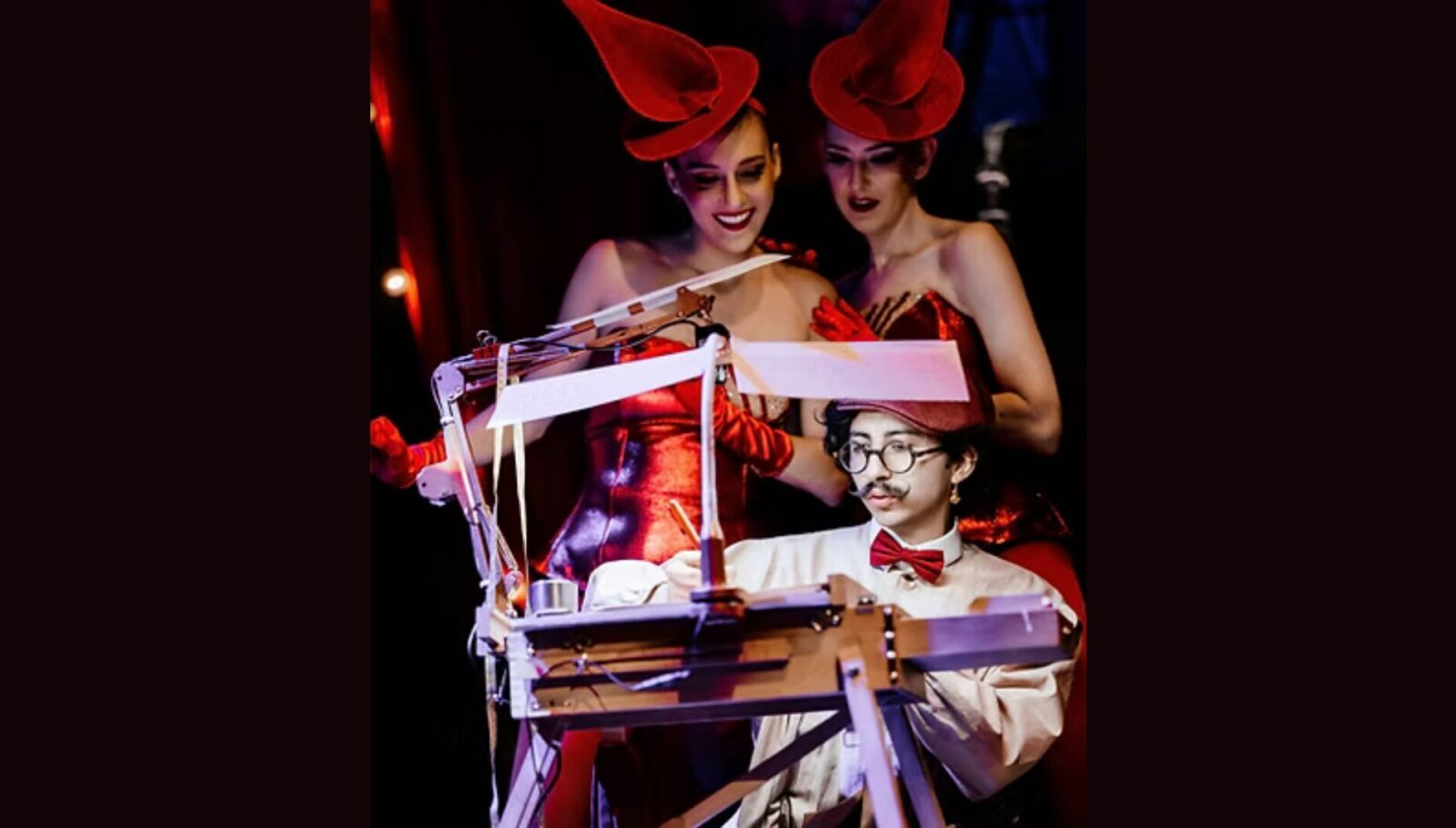
So how does one stage a form of entertainment particularly associated with pomp, an aesthetic of overwhelming grandeur, and formalism in a place that stands for the intimate connection with the audience? “Rouge” employs the stylistic form of homage. Right from the start, the audience is transported to the atmosphere of Montmartre by the quick-sketch artist Ernesto Lucas in the role of a Parisian bohemian artist. “There are five dramatic strands that we weave together,” explains Urs Jäckle, “dance, acrobatics, a singer, the band as performers, and the painter, who acts as a kind of window, as if looking out onto Montmartre.” The artists are introduced with short stories, and theatrical interactions highlight the performers as individuals. Comedy magician Raymond Raymondson ensures that nothing is taken too seriously. And the band is moving on the stage in an active role.
The aim is not to reproduce the grand revues of bygone eras, but to immerse oneself in the spirit of those who made them possible. The artistic acts—including juggler Andy Jordan, aerial silk and handstand artist Veronica Fontanella, and the “Trio Beautiful” with its adagio acrobatics – blend seamlessly into the scenery.
Is “Rouge” ultimately more of a variety show with a revue theme or a revue with a strong emphasis on acrobatics? It doesn’t matter at all, it’s good entertainment – and a welcome opportunity to explore the common origins of Varieté and revue.
Teaser der Show “Rouge” im Krystallpalast
[1] Romain Piana, La revue théâtrale de fin d’année en France au XIXe siècle,Hermann, Paris 2025
[2] Anne Fleig, Tanzmaschinen. Girls im Revuetheater der Weimarer Republik. In: Sabine Meine, Katharina Hottmann (Hrsg.): Puppen, Huren, Roboter. Körper der Moderne in der Musik zwischen 1900 und 1930. Edition Argus, Schliengen 2005
Featured Image: The Varieté Revue "Rouge" lets you immerse yourself into the artist community of Paris. (c) Krytallpalast Varieté
This article was originally published at Scenic Circus.

Editor's Note: At StageLync, an international platform for the performing arts, we celebrate the diversity of our writers' backgrounds. We recognize and support their choice to use either American or British English in their articles, respecting their individual preferences and origins. This policy allows us to embrace a wide range of linguistic expressions, enriching our content and reflecting the global nature of our community.
🎧 Join us on the StageLync Podcast for inspiring stories from the world of performing arts! Tune in to hear from the creative minds who bring magic to life, both onstage and behind the scenes. 🎙️ 👉 Listen now!
