High Risk Performance Environments and Physiological Adaptation
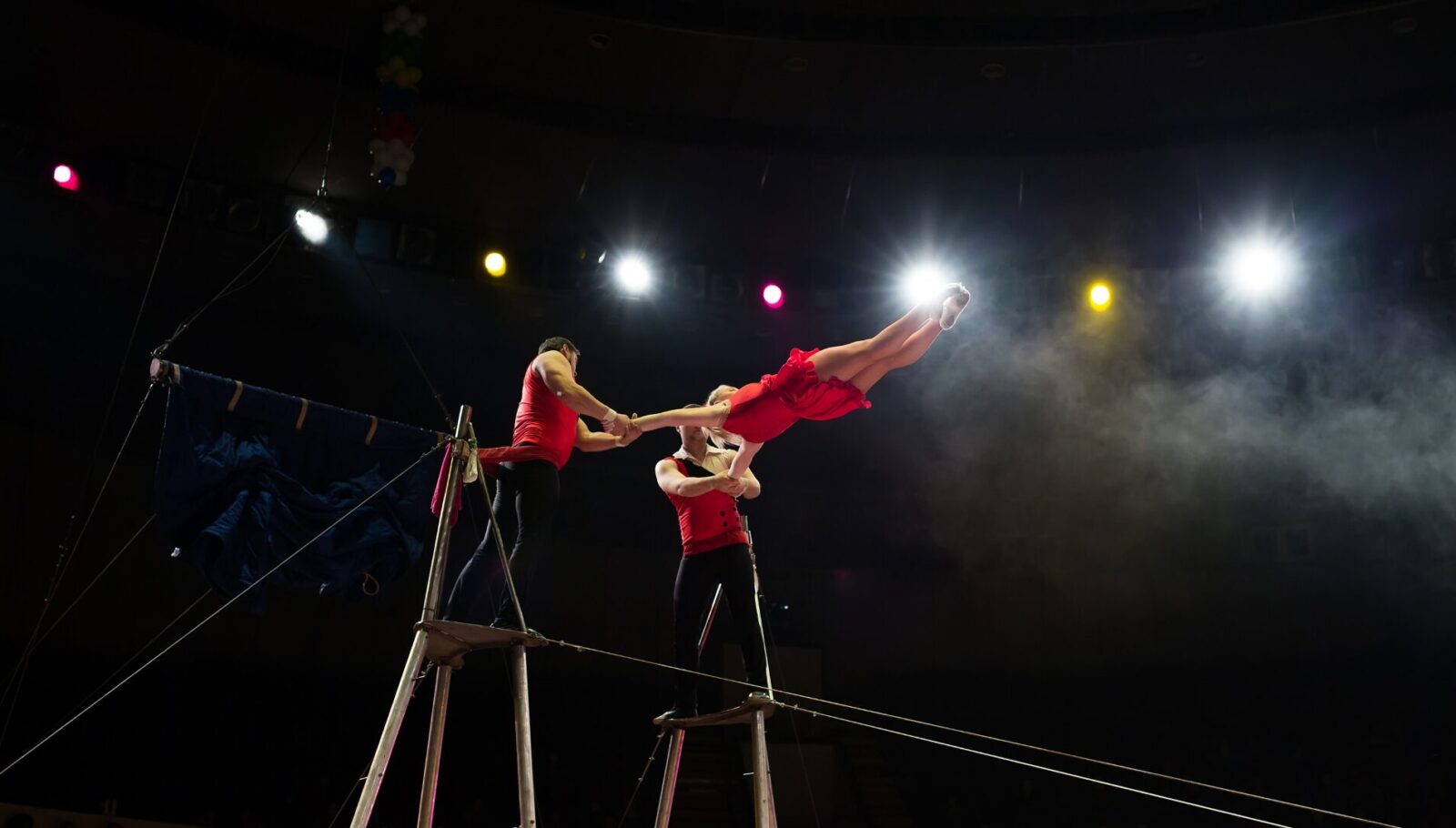
High-performance disciplines that involve elevated physical risk—such as aerial arts, gymnastics, acrobatics, and other movement-based practices—are often discussed in terms of physical preparation: strength, technique, conditioning, and repetition. However, less attention is given to the psychological adaptation required to work with skills in which control is never fully guaranteed.
This article explores how performers develop the ability to operate under conditions of uncertainty, where stability cannot be fully achieved and risk remains present regardless of experience level. Drawing from long-term professional practice in high-risk aerial work, it examines how fear evolves over time and how performers learn to maintain execution without being disrupted by it.
Rather than approaching fear as a limitation, this text considers it an integral component of high-performance environments. Particular focus is given to how attention is managed under pressure, how trust is rebuilt after failure, and how performers distinguish between adaptive caution and fear that interferes with execution.
While grounded in experience from aerial practice, the reflections presented here are applicable across a wider range of disciplines that require consistent performance under risk. The article contributes to an ongoing conversation about psychological resilience, decision-making, and embodied awareness in environments where certainty is not possible.
Working in Conditions That Never Fully Stabilize
Certain high-risk skills resist becoming routine. Repetition improves efficiency, but it does not create full certainty. Each execution is slightly different, and the body must continuously adapt in real time.
In this context, mastery is not built on predictability. It is built on attention. Over time, I learned that focusing on what might go wrong increases instability, while focusing on physical sensation—contact, pressure, alignment—creates clarity. The goal is not to remove uncertainty, but to work inside it without losing control of execution.
How Fear Changes With Experience
For less experienced performers, fear often appears before the attempt. With experience, it tends to appear during execution, when the body is already committed.
One of the most important distinctions I learned is that the sensation of “losing control” is not always accurate. In many cases, the body is still holding, and what has shifted is not the mechanics, but trust. Recognizing this difference changes how you respond. Instead of reacting to the thought, you return attention to what is physically happening.
This shift—from reacting to imagined outcomes to responding to real-time sensation—is a key part of psychological adaptation.
Returning After Failure
After a slip or fall, the most significant impact is often psychological. If the experience is left unresolved, fear can reorganize the memory of the event and become stronger over time.
In my practice, immediate return has been essential. Repeating the skill soon after failure allows the body to confirm what actually happened, before imagination takes over. This is not about forcing repetition, but about preserving an accurate connection between action and perception.
When return is delayed, fear tends to grow independently of physical reality. When return is immediate, the experience remains grounded in sensation and is less likely to become a long-term barrier.
Distinguishing Useful Fear From Interference
Not all fear is negative. In high-risk environments, fear can provide important information—but only when it is connected to real physical conditions.
There is a clear difference between fear that reflects actual instability and fear that arises without a change in contact or control. The first is precise and grounded. The second is often driven by anticipation.
Learning to distinguish between the two allows for better decision-making. It protects the body when necessary, and prevents unnecessary interruption when the skill is still stable.
Managing Attention Under Risk
One of the most effective adjustments I made over time was learning where to place attention.
Focusing on external factors—such as height or potential consequences—consistently increased tension and reduced control. Shifting attention back to the body—contact, pressure, balance—improved precision and stability.
The risk does not disappear, but it becomes manageable when attention is anchored in real-time sensory feedback rather than imagined outcomes.
Working With Risk Over Time
Some high-risk skills never become fully safe. The long-term goal is not to eliminate risk, but to build a stable relationship with it.
Fear remains part of the process, but it no longer dominates execution. Trust is not built on certainty, but on repeated confirmation that the body can respond effectively under changing conditions.
In high-performance environments, psychological adaptation is not a separate skill. It is part of the practice itself.

At 16, she started working professionally, including performances at events for the Princess of Monaco—an early milestone that set the tone for her career: high-level stages, real responsibility, and the constant demand to deliver under pressure. Since then, Yelyzaveta has performed across multiple countries and formats, from touring circus productions to television projects, bringing together precision, control, and a clear artistic style.
Her work is defined by clean lines, strong artistic choices, and a calm, confident presence on the apparatus. She is especially known for rare, high-level elements on aerial hoop that require not only strength, but also timing, focus, and the ability to keep the performance alive—not just technical.
Today, alongside performing, Yelyzaveta speaks more openly about what is often left unsaid in circus. Every year, artists make avoidable mistakes—and people fall from the air. This reality cannot be ignored. Through writing and professional discussion, she aims to support performers, coaches, and productions in treating risk with the seriousness it deserves, and in building a culture where experience is shared before someone gets hurt.
Back to Home
high risk performance high risk performance high risk performance high risk performance
Editor's Note: At StageLync, an international platform for the performing arts, we celebrate the diversity of our writers' backgrounds. We recognize and support their choice to use either American or British English in their articles, respecting their individual preferences and origins. This policy allows us to embrace a wide range of linguistic expressions, enriching our content and reflecting the global nature of our community.
🎧 Join us on the StageLync Podcast for inspiring stories from the world of performing arts! Tune in to hear from the creative minds who bring magic to life, both onstage and behind the scenes. 🎙️ 👉 Listen now!
