Mastering the Element: Safety in Fire Performance
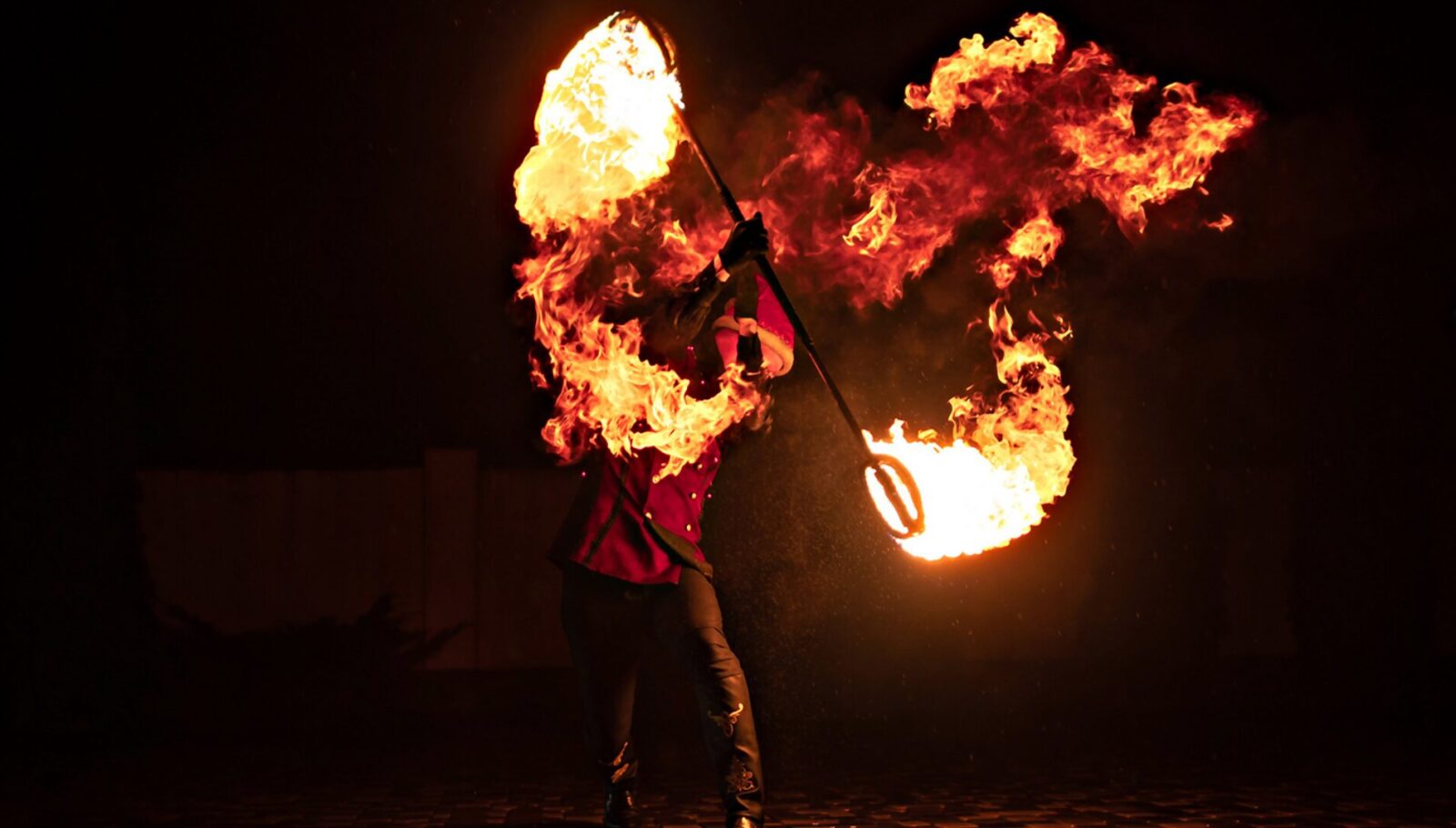
Fire performance is one of the most visually striking genres of contemporary performing acts. Flame immediately captures attention and creates an atmosphere of tension that evokes both fascination and a natural sense of danger in the audience. This duality – beauty and risk – forms the unique dramaturgy of fire performance.
However, behind the impressive visual spectacle lies a complex system of preparation and control. In professional practice, fire is never treated as a chaotic element; it becomes a controlled artistic tool. Safety in fire performance is not merely a technical concern – it is the foundation upon which the entire performance is built.
Fire as an Element of Responsibility
Working with open flame requires a deep understanding of its nature. Combustion temperature, wind direction, fuel type, and the properties of the equipment all influence how fire behaves during a performance and affect the overall level of safety.
To the audience, a fire act may appear effortless or even improvisational. In reality, every movement and every element of the performance is carefully planned and rehearsed. A professional fire performer must act not only as an artist but also as a safety specialist.
Responsibility extends far beyond the performer. It includes the surrounding environment, the audience, the technical team, event organizers, and the architectural characteristics of the venue. For this reason, preparation for a fire performance begins long before the performer steps onto the stage.
Equipment Preparation and Technical Inspection
One of the key components of safety in fire performance is the proper preparation of equipment. Fire tools – including poi, staffs, fire fans, torches, dragon staffs, and double staffs – must be regularly inspected and maintained.
Important aspects include:
The condition of metal structures
The strength of joints and connections
The quality of the wicks
The reliability of all attachments
Even minor damage can lead to dangerous situations, which is why professional performers always conduct a technical inspection of their equipment before every performance.
Fuel selection is also crucial. Different countries and performance venues may require different types of fuels, each with its own burning characteristics. Understanding these properties allows performers to control flame height, burn duration, and heat intensity.
Most professional performers use purified or aviation kerosene, as well as paraffin-based fuels. These fuels tend to produce a more stable flame, generate less smoke, and are considered relatively safer when handled properly.
Gasoline, on the other hand, is used much less frequently because of its extremely high combustion temperature, its ability to accelerate the mechanical wear of equipment, and its explosive properties. It is particularly important to emphasize that gasoline should never be used for fire-breathing or fire-eating techniques. Due to its toxicity, it can cause severe intoxication and serious health risks.
Performance Space and Environmental Considerations
Another essential aspect of safety is the analysis of the performance space. Fire performance requires sufficient distance between the performer and the audience, as well as careful consideration of the surrounding environment.
Before the performance begins, several factors must be evaluated:
The size of the performance area
The presence of flammable objects nearby
Ceiling height in indoor venues
Weather conditions such as wind, rain, or snow
The placement and movement of the audience
Sometimes, a location that appears suitable for a regular performance may prove unsafe for a fire act. In such situations, a professional performer must be prepared to modify the choreography or remove certain elements of the act.
Professional fire performance also requires safety equipment to be present near the performance area. This typically includes a first-aid kit, fire extinguishers, fire blankets, and containers of water. These precautions are rarely visible to the audience, yet they remain an essential part of the preparation process.
The Psychological Dimension of Safety
Working with fire requires not only technical expertise but also psychological stability. A performer must maintain a high level of concentration while operating under physical pressure and intense audience attention.
Fear is a natural response when interacting with fire. However, professional training allows performers to transform this fear into a tool of heightened awareness. Breath control, stable movement, and the ability to react quickly to unexpected changes become part of the performer’s discipline.
In this sense, fire performance is closely related to other forms of extreme stage practice where psychological resilience plays a central role. It is important to understand that safety does not restrict artistic freedom. On the contrary, it enables the performer to work with confidence.
When a performer is fully secure in the technical aspects of the performance, they are free to focus on expressive movement, dramaturgy, and interaction with the audience.
Safety itself becomes part of the directing process. Pauses for extinguishing, transitions between props, and the placement of fire sources on stage can all be integrated into the structure of the performance. In this way, technical discipline evolves into a component of the artistic language.
Professional Standards in the Field
As the performing arts industry and festival culture continue to grow, fire performance is becoming increasingly visible. This growth has led to a rise in the number of performers and projects working with fire. Under these conditions, the development of professional standards becomes especially important.
Education, knowledge exchange, and strict adherence to safety principles help maintain fire performance as a responsible and respected form of performing art.
A professional fire performer must possess not only artistic ability but also technical competence. It is precisely the combination of these qualities that allows performers to create visually powerful yet safe performances.
Conclusion
Fire performance exists at the intersection of art and elemental force. Much of its expressive power is built upon the audience’s perception of risk.
Yet behind that perception lies a sophisticated system of preparation, knowledge, and discipline. Safety in fire performance is not a limitation but the very foundation of the art form.
When fire is truly under control, it ceases to be a threat and becomes a partner to the performer. Within this relationship, a unique form of stage presence emerges – one where beauty and responsibility coexist in balance.

At 18, Makasheva created her original theatrical work “Muse: A Love Story”, which she wrote, directed, and performed, marking an early transition toward authorship and independent artistic vision.
Expanding beyond theatre, she entered the field of contemporary performance and circus arts, collaborating with Demidov Show Circus as part of its show ballet ensemble. Her work integrates high-risk elements such as fire and height with expressive movement and audience psychology.
In 2023, she performed in a large-scale pyrotechnic production at the rock festival Stairway to Heaven Festival. Her international experience includes performances in Turkey and Saudi Arabia (2024–2025), where she worked across diverse cultural and entertainment contexts.
Makasheva is also the creator of the authorial methodology “Integral Stage Mastery”, a multidisciplinary system that combines performer psychology, energetic presence, risk transformation, and dramaturgy. Her method focuses on developing a powerful stage identity and deep audience engagement through psychophysical techniques.
Her artistic practice is defined by the fusion of extreme performance elements with theatrical depth, positioning her as an emerging voice in contemporary performance art.
Back to Home
Editor's Note: At StageLync, an international platform for the performing arts, we celebrate the diversity of our writers' backgrounds. We recognize and support their choice to use either American or British English in their articles, respecting their individual preferences and origins. This policy allows us to embrace a wide range of linguistic expressions, enriching our content and reflecting the global nature of our community.
🎧 Join us on the StageLync Podcast for inspiring stories from the world of performing arts! Tune in to hear from the creative minds who bring magic to life, both onstage and behind the scenes. 🎙️ 👉 Listen now!
