Chwallow: When Circus Becomes Monochrome
This article is part of the “Inter-magazine Circus Festival 2026” project that is a collaboration between the UP- Circus & Performing Arts Festival, the Université Libre de Bruxelles and six international circus magazines: Juggling Magazine, Stage Lync, Zirkólika, DYNAMO Magazine, Sztuka Cyrku, CIRQUEON, all part of the INCAm network. Students at Université Libre de Bruxelles share their thoughts on current stage and circus performances. Their diverse backgrounds ranging from literature and journalism, to acting and cultural studies bring unique perspectives, whether already familiar with the art form or newcomers. They are united by a curiosity about performing arts, which led them to the MA Arts du spectacle program, offering exposure to various art forms, including the circus. As part of the interdisciplinary and international project Circus | Studies led by Dr. Franziska Trapp, theatre students explore circus, collaborate with emerging artists, and engage in performance analysis and critique. Their experiences culminate in MA theses or articles like the one that follows.
As the audience settles into the bleachers, a large white canvas stretches across the stage, suspended by cables a metre above the ground. When the lights rise, the space slowly begins to come alive. For seventy minutes, actions unfold without clear narrative progression.
Instead, the space undergoes a gradual transformation: touches of colour accumulate until the entire environment blends into a saturated orange monochrome. Presented as the first laureate of a new funding scheme dedicated to « interdisciplinary circus creation », initiated by UP – Circus & Performing Arts and Théâtre Varia (Brussels),Chwallow, directed by Julien Fournier (Cie Habeas Corpus, BE), stands out within this year’s UP Festival for its radically minimal and abstract aesthetic. Although no brushes or paint are visible on stage, its communication foregrounds references to the visual arts, and painting in particular (1). While this intermedial approach resonates with a broader tendency in contemporary circus to engage with visual arts practices, the nature of this dialogue remains to be examined.What does it mean for circus to become monochrome?
A reduction that opens up new possibilities
At first glance, circus and monochrome, understood within the history of painting, seem to have little in common. Circus has long been associated with a profusion of colours, visual excess, and spectacular intensity. By contrast, monochrome, which emerged as a major turning point in twentieth-century painting, is defined by a radical reduction of chromatic means.
Why would artists choose to limit themselves to a single colour?
I think here of the radicality of Marthe Wéry, one of the most significant Belgian artists of the second half of the twentieth century. In her monochrome works of the 1980s, she pushes the limits of painting by decomposing its constitutive elements: frame, surface, layers of colour, but also the space in which the work is situated and the way light affects it. The absence of representation does not impoverish the work; it shifts its perception: what was previously background comes to the foreground, revealing the very conditions of its making (2). Although this comparison may seem bold, it offers a way of understanding the logic at work inChwallow.
The company’s name “Habeas Corpus” suggests a central affirmation of the body as political subject, scenic material, and primary tool of the circus artist. Paradoxically, the body is at first absent from the stage. White predominates. Through a set design created in collaboration with Studio Marie Douel, the performance unfolds initially on a sculptural level: fabrics stretch and collapse, thousands of polystyrene balls, reminiscent of juggling apparatus, slide, scatter, and reassemble into unstable volumes. As the chromatic palette narrows, other elements intensify. Textures proliferate: plastic, textile, smoke, even slime.Chwallow emerges as a laboratory in which circus seems to confront its own limits. Transformations become more perceptible, and light (designed by Arié Van Egmond) and sound (performed by Fred Miclet) cease to function as accompaniment, becoming structuring principles instead.
Inhabiting the monochrome
While we are watchingChwallow, the monochrome does not erase representation but alters how we perceive it. Figures, gestures, and situations come into view in what could be described as a succession of composed images, almost as “living tableaux”. Within each of these “tableaux”, the scenography evolves, shifts in colour, and becomes a new environment to explore; an ecosystem to manipulate as much as to inhabit. Movement temporarily stabilises into images, somewhere between live arts, sculpture, and painting.
Small balls emerge from behind a stretched canvas and slowly slide towards its centre. For several minutes, they constitute the sole focus of attention. Movement is induced through gravity and tension on the surface, rather than through visible human action, accompanied by intriguing, almost meditative, metallic-sound textures. When performers eventually appear, their presence does not re-establish a clear hierarchy. A tension between stillness and movement, human and object, runs throughout the piece. Two performers sit at the edge of the canvas, watching a cluster of balls gathered at its centre. The balls begin to move on their own, bouncing with a joyful bubbling sound. No words are spoken. Small microphones placed close to their faces only capture sounds, laughter, and fragmented exclamations that blend into the soundscape. Dressed in painter-like white overalls and wearing white, half-spherical headpieces reminiscent of the balls that partially obscure their heads, the performers appear almost interchangeable. Their costumes, designed by Marie Artamonoff, do not impose meaning but enter into an already active system, extending its logic. Like the scenography, they gradually take on the orange colour, participating in the unfolding transformations of the stage environment. The white and orange palette sometimes acts as a device of visibility: in a scene where a rectangular space on the floor is filled with white balls, the orange gloves suddenly stand out against the white costumes and scenography.
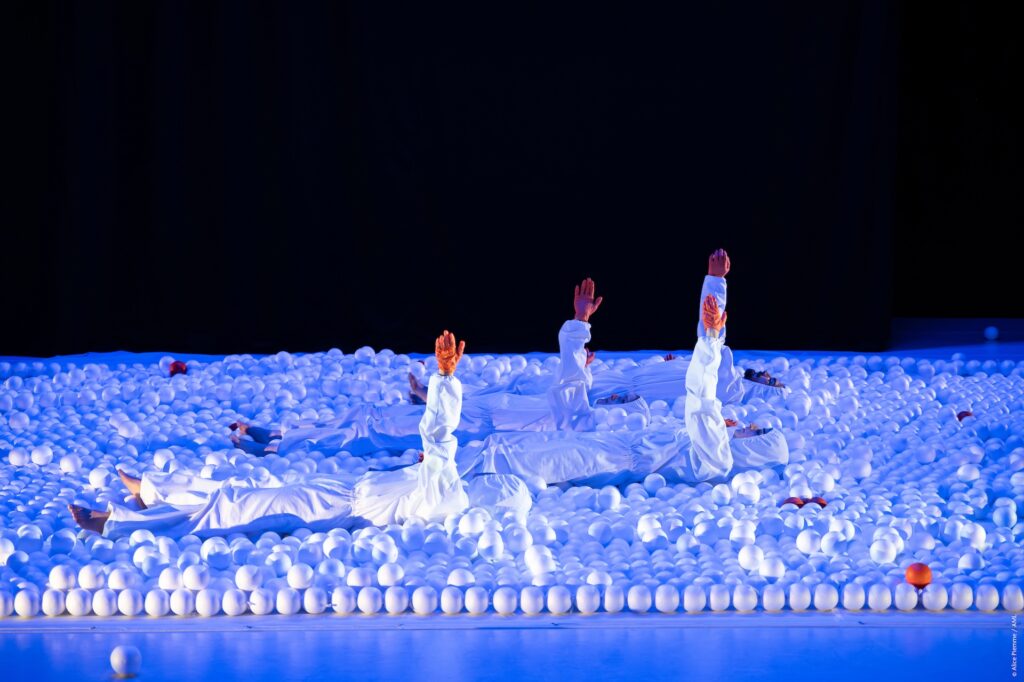
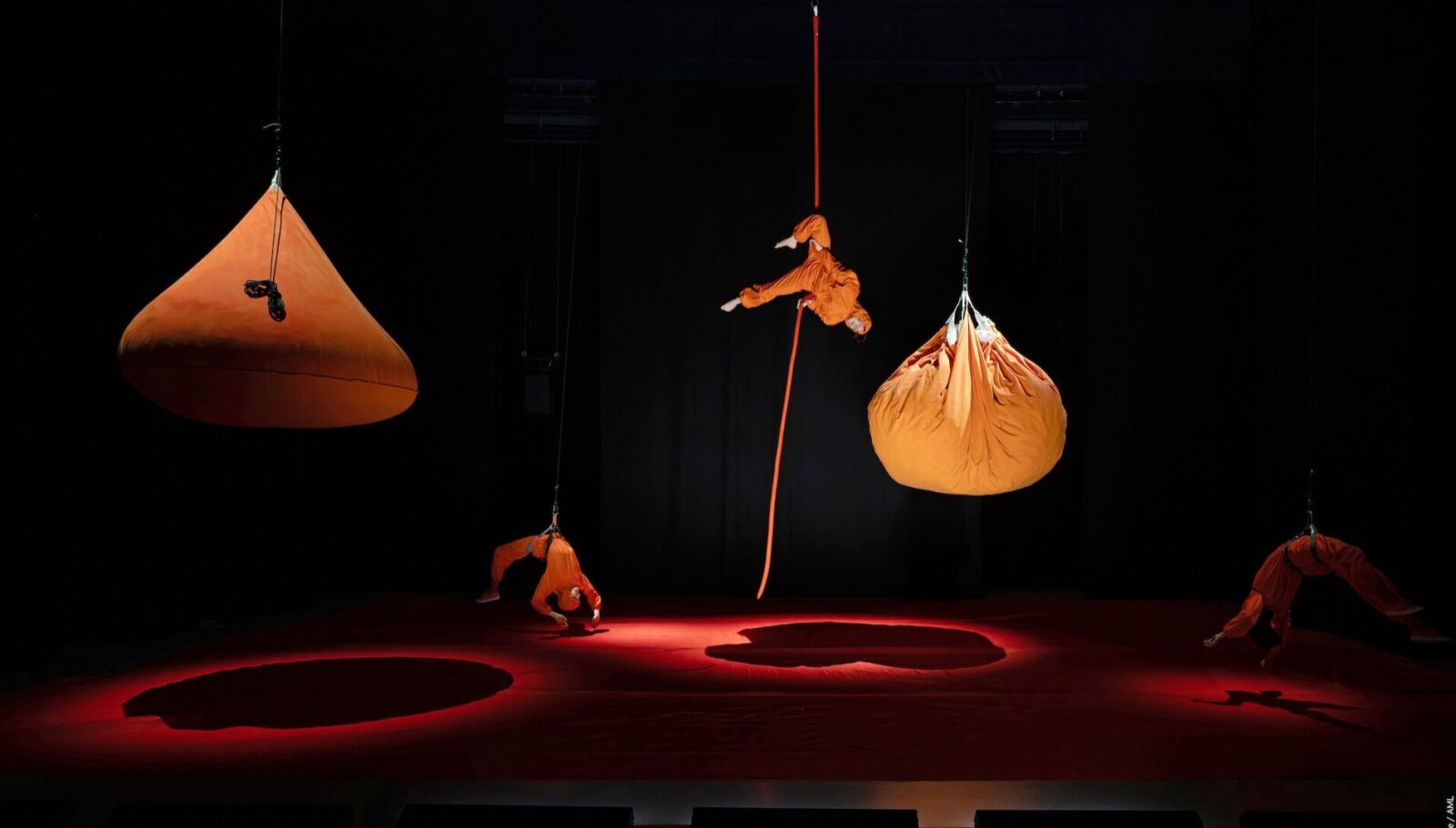
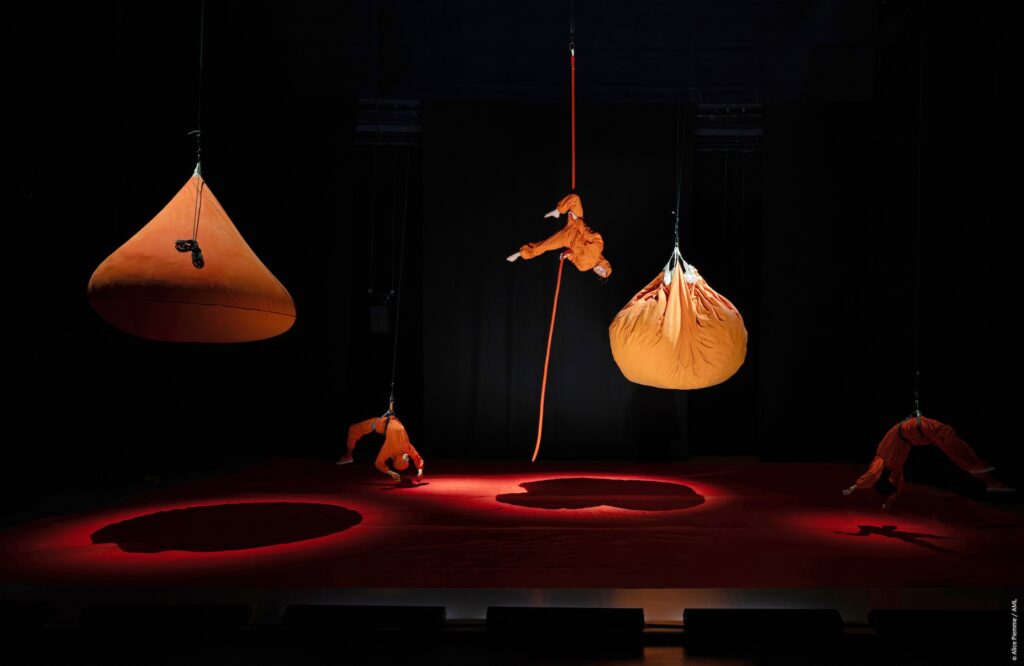
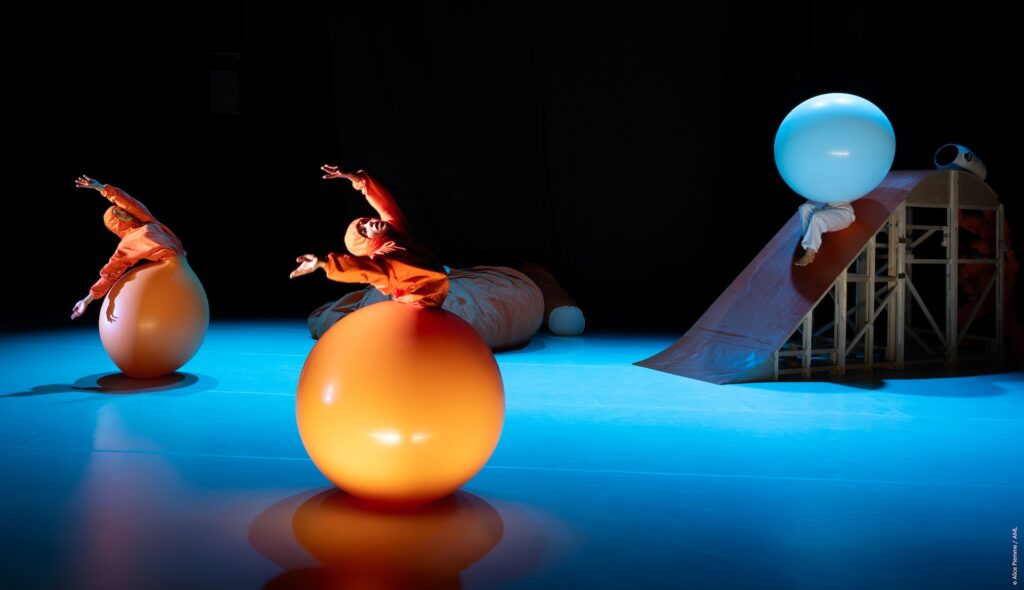
In this context, movement becomes relational. It emerges through interactions between bodies and materials, such as when four performers slide within a square of white balls, forming a choreography reminiscent of synchronised swimming. While engaging with the physical properties of this environment, the performers maintain a certain degree of control over it. Within this dynamic, the circus body itself becomes a plastic material. At times, music seems to act directly upon it. On other occasions, their movements echo those of the rolling balls or of a viscous substance, probably slime, slowly sliding along a surface. This malleable, deformable body becomes particularly visible when large inflatable balloons appear: two orange ones envelop the legs of contortionists, while a white one covers the upper body of another performer from the waist up. Here, the human physicality is reshaped, and movement adapts to as well as plays with this new plasticity. This interdependence between bodies and the scenographic environment reaches a climax towards the end of the piece, when two performers, attached by harnesses to large orange modules functioning as counterweights, have their movements physically linked to the dispositif, while another performer ascends a rope.
Watching from a distance
As spectators, we are invited to observe a system in operation rather than follow a story. The performance unfolds in an abstract, sometimes meditative mode, occasionally evoking a form of vintage science-fiction. Yet, at times, this abstraction condenses into short, more recognisable sequences, introducing a slightly more “human” dimension. For instance, performers momentarily appear as gardeners, raking a pool of white balls; like a Zen garden with oversized rakes. Elsewhere, the balls become objects of harvest: performers handle them like fruits, smelling and gathering them into their hats turned into baskets. These fleeting scenes, reminiscent of pantomime, rely on gestures, attitudes, and facial expressions rather than speech, occasionally producing a subtle clownesque quality, especially when a performer on roller skates, equipped with a vacuum cleaner, awkwardly attempts to collect the balls to the sound of what resembles hold music.
Yet, the fourth wall is never truly broken. This maintains a distance that reinforces what the presentation text aptly describes as an « entomological » (3) mode of spectatorship. The frontal theatrical dispositif further supports this dynamic. The performance thus operates as a space of projection. Its aesthetic, marked by abstraction and indeterminacy, invites spectators of all ages to construct their own meanings, effectively becoming co-producers who add a layer to the ongoing fabrication of the artwork.
*
ExaminingChwallow through the lens of monochrome reveals that it is not merely an orange-tinted set emerging in the final scene, but a layered process that runs through scenographic materials and moving bodies, which redirects the spectator’s perception. In painting as in circus, monochrome tends to become a sensory milieu rather than a mere background. The acrobatic body, usually sovereign, becomes one material among others: colour and matter do not decorate a narrative, they become the very object of attention.
IMAC #3: An Inter-magazine Circus Festival summer 2026
(1) « A white immensity welcomes you, like a painter’s canvas. » [ personal translation from French: « Une immensité blanche vous accueille, comme la toile d’un peintre. »], Chwallow, festival UP programme page, https://upupup.be/show/chwallow/?show_context=festival-up, accessed 7 April 2026.

(2) Example: Peinture Venise 82, presented in the Belgian Pavilion at the Venice Biennale in 1982. Stretched canvases on rectangular frames of varying sizes are covered with successive layers of translucent colour, applied over blue or green grounds and gradually building up to more or less intense reds. The works are displayed leaning against the wall, allowing them to capture light and reveal their three-dimensionality, https://www.centrepompidou.fr/fr/ressources/oeuvre/cbqkpqR, accessed 10 April 2026.

(3) Chwallow, Varia programme page, https://varia.be/programme/2025-2026/julien-fournier/chwallow, accessed 10 April 2026.

Editor's Note: At StageLync, an international platform for the performing arts, we celebrate the diversity of our writers' backgrounds. We recognize and support their choice to use either American or British English in their articles, respecting their individual preferences and origins. This policy allows us to embrace a wide range of linguistic expressions, enriching our content and reflecting the global nature of our community.
🎧 Join us on the StageLync Podcast for inspiring stories from the world of performing arts! Tune in to hear from the creative minds who bring magic to life, both onstage and behind the scenes. 🎙️ 👉 Listen now!
