How to Build a Calling Script for Ballet
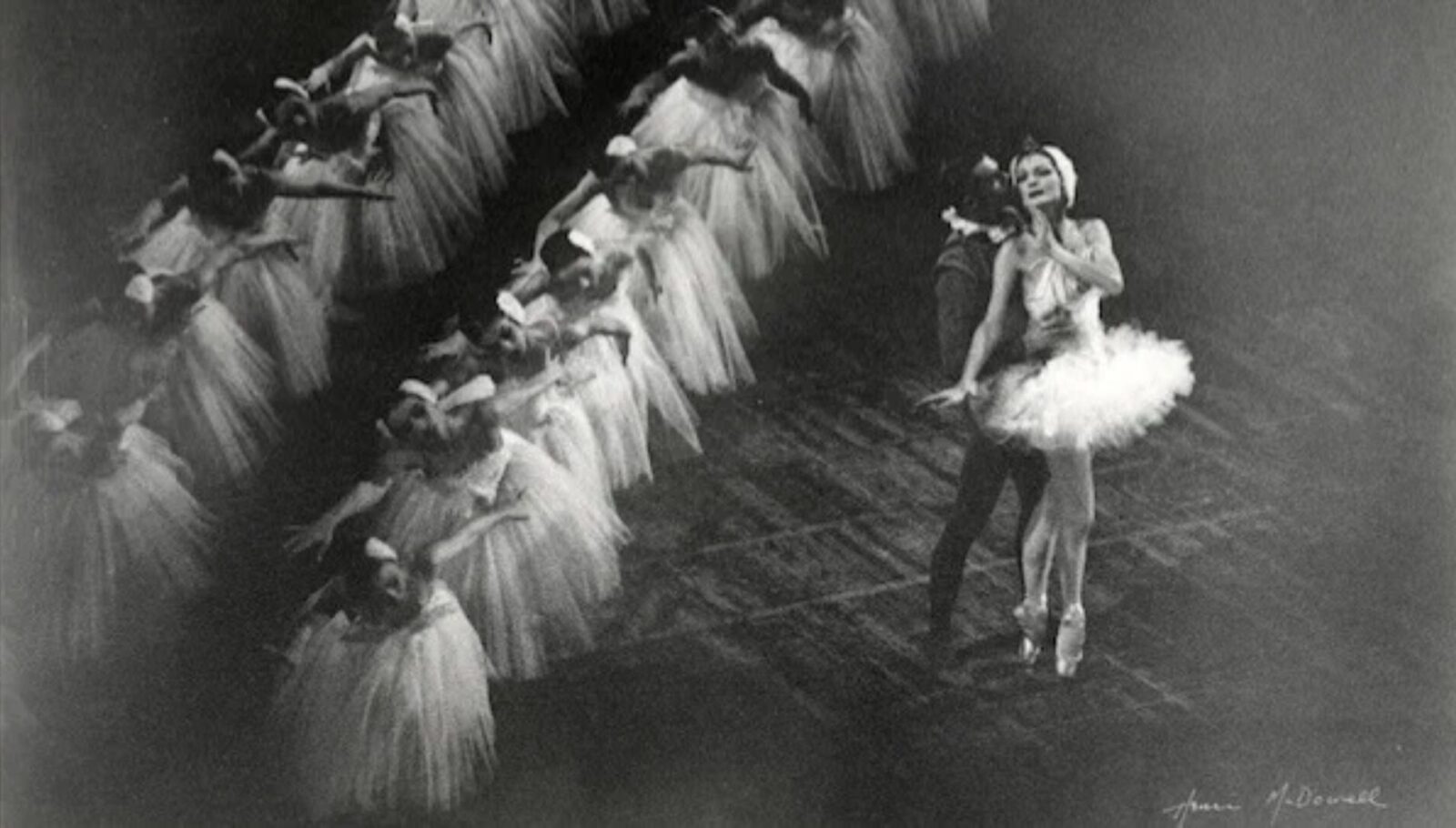
There’s an old adage we throw around in theatre: being “hit by a bus.” It means that if you’re suddenly unable to come in, someone else can pick up your paperwork and run the show. It’s improbable, unpredictable, and it has happened to me. Here are four ways to call a dance performance — and why your prompt book should be ready for someone else’s hands.
How to Build a Calling Script for Ballet
There is an old adage we throw around in the theatre: being “hit by a bus”. You could call it “winning the lottery” if you want a positive spin. It means that in the case that you are absolutely unable to come into work that day, someone can pick up your paperwork and run the show for you. Being “hit by a bus” is improbable and unpredictable, yet it happens. It’s happened to me! One Saturday afternoon, after an exhausting tech week and no matinee performance, I lay down to take a nap after starting a load of laundry. The next thing I knew, it was 7:15pm. I had a dozen missed calls from coworkers, and the police were on their way to my house for a wellness check. I had forgotten to set an alarm and fell asleep for six hours. Thankfully, I made it to the theatre in time for the first piece. But if I didn’t, someone would have to take my place. This is why we prepare for the metaphorical bus. Whether you are an aspiring dance stage manager or someone preparing for your own worst-case scenario, knowing the different ways to call a dance performance is a great skill to have in your tool belt.
At its core, dance is story and emotion portrayed through movement. You don’t need to speak the same language as the performer to understand what is being conveyed onstage. Artistically, this is truly special. As a stage manager calling a show, it can be tricky. There is no set script like there is for a traditional theatre show like a play or musical. Choreography for the most well-known ballets like Swan Lake can vary from company to company. George Balanchine famously inserted a section of music from Sleeping Beauty into his production of The Nutcracker for New York City Ballet.
All this to say, it’s important to be flexible when creating a book for a dance show. If you find yourself taking over for another stage manager or creating a dance calling script for the first time, it is in your best interest to be familiar with the common types of score, scripts, and prompts you may encounter.
Calling a Ballet from a Score
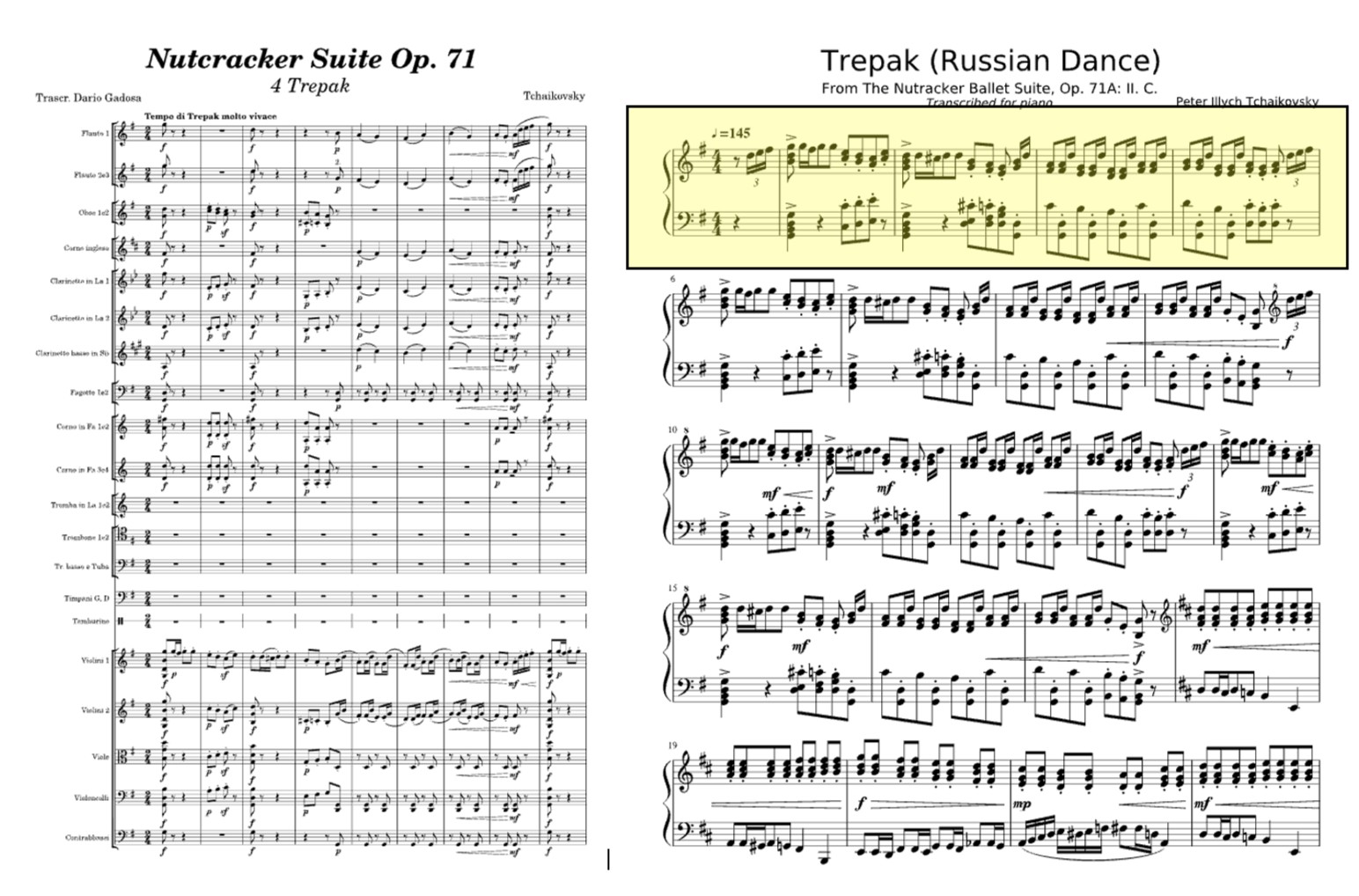
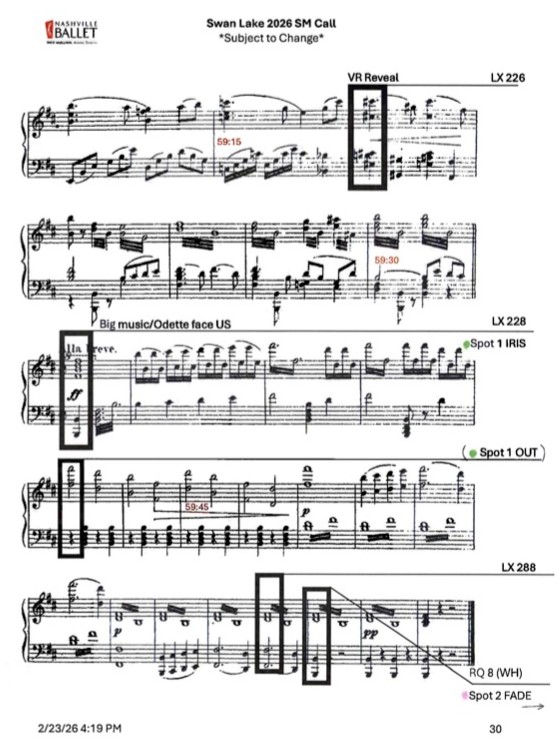
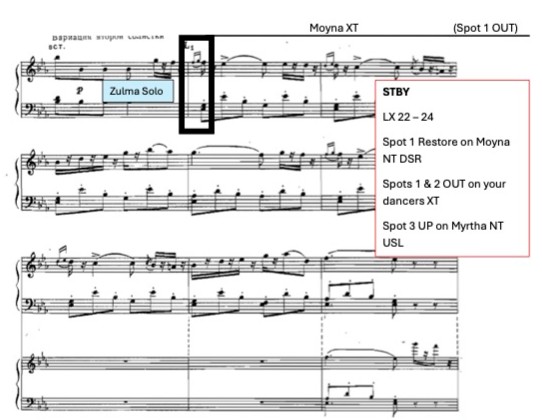
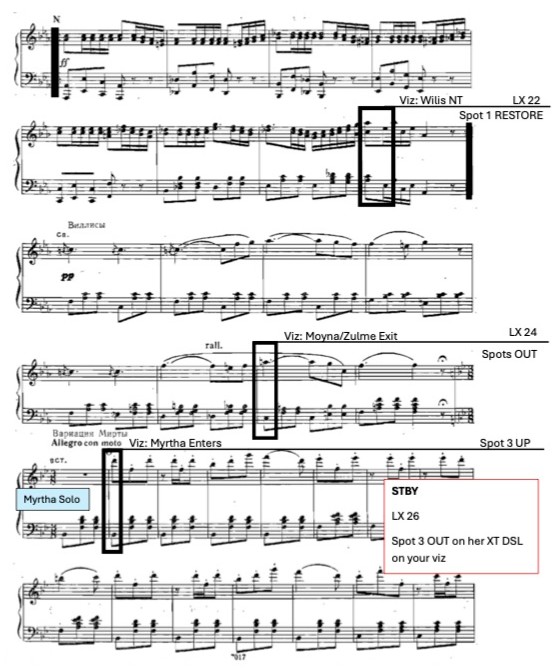
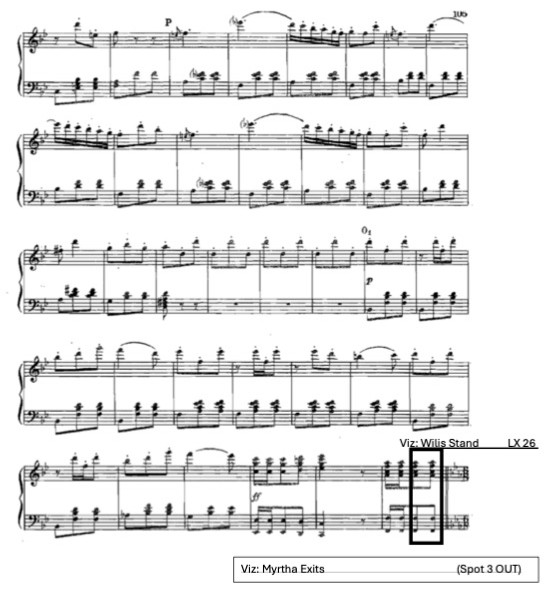
A classic way to call cues in ballet and dance is by using the score. Most classical ballet scores are easy to find online or in your organization’s archives. Much like calling an Opera, you have to know the music well and be able to follow along without losing your place to be a successful show caller using this method. I recommend using the piano reduction rather than the conductor’s score. The piano reduction is made for one person, the rehearsal pianist, to play by themselves. It gives you all the melodies and patterns you hear in a full orchestra score without having to read every single line of music for each instrument.
Below is an example of a conductor’s (or full) score next to the piano reduction of the same piece of music from The Nutcracker. The highlighted system on the piano reduction matches music on the page of the conductor’s score.
Pros and Cons of calling from a score
Pros:
Following a score can allow you to call the show very consistently every single performance.
If all parties (designers, directors, music directors, etc.) are working from the same script, placement of cues and notes is easy to notate and move.
This is the most universally used and understood way to call classical ballet pieces. You are more than likely to encounter at least part of a score if you are working for a dance company.
Cons:
You must be able to read music at some level of proficiency. I read music at about an 8th grade level, which gets me by just fine. Many dance stage managers can’t read music and are great show callers.
Scores are not always readily available. Contemporary works are often danced to soundscapes, spoken word, or nothing at all. Relying solely on a score can be restrictive depending on the type of work being produced.
Not all cues are placed musically. Some cues are called on a specific moment or movement that may vary slightly night to night. Make sure to notate when cues are called off a visual instead of a musical marker.
Swan Lake (Paul Vasterling Ⓒ)
Calling a Ballet from Written Notation
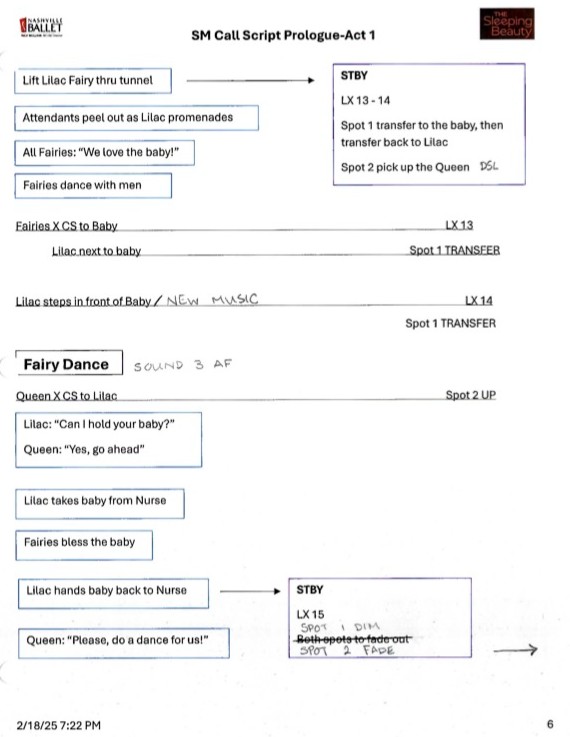
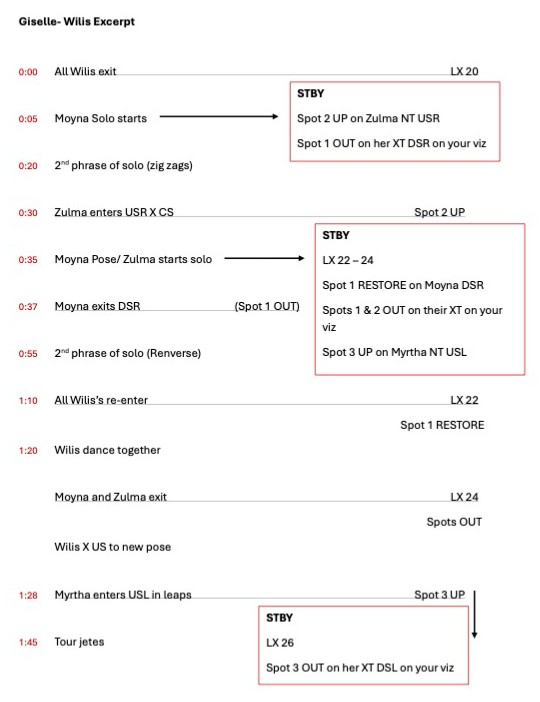
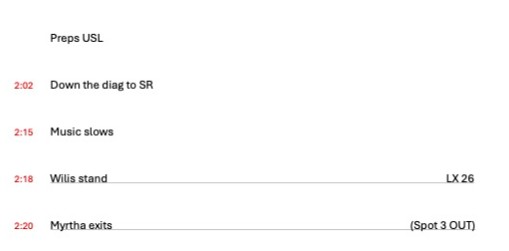
Dance famously has no spoken words (except sometimes when it does; we will discuss that later), so there is no script to base your prompt book off of. Using a video or by taking notes in rehearsal, you can create your own “script” based on the choreography. I prefer this method for remounted story ballets where the cues are already set. That way I can use a performance video, the old version of the call, and the cue sheets to create a new version of the prompt. Noticing where the cues are, I can predetermine where standbys and G-O’s should be. It is still important to know where you are in the context of the whole piece, which is why I like to put “landmarks” into my script. To me, these are can’t-miss movements that let me follow along with the dancers and musicians even if there are no cues. Putting these in your book will also give you a clearer sense of pace. Otherwise, you may as well be calling from the lighting designer’s cue sheet.
Pros and Cons of calling from written notation
Pros:
This version of a prompt book is the most efficient use of space on a piece of paper because it is most like a traditional script.
It provides freedom to customize your book using this method because you are truly creating from the ground up.
Cons:
What makes sense to you won’t always make sense to the next person to pick up your book. They may be used to calling from visuals or counts and can take a moment to understand what you have written.
It can be difficult to express time using written format. Be sure to include timestamps to mitigate this potential issue.
The Sleeping Beauty (Paul Vasterling Ⓒ)
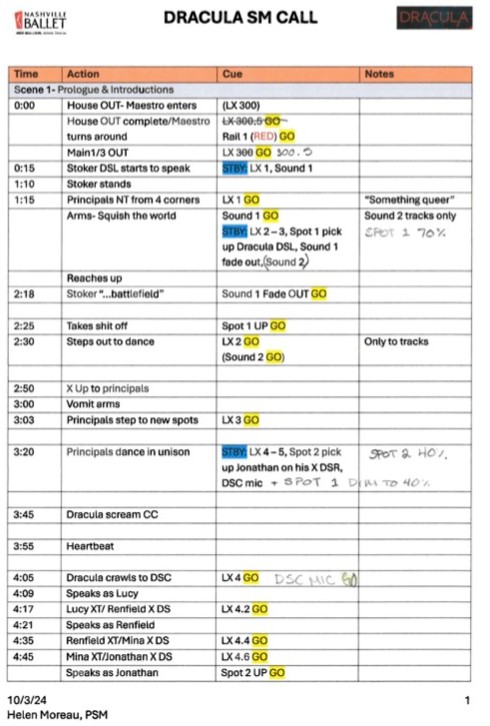
Dracula (Paul Vasterling Ⓒ)
Calling a Ballet from Dance Tracking
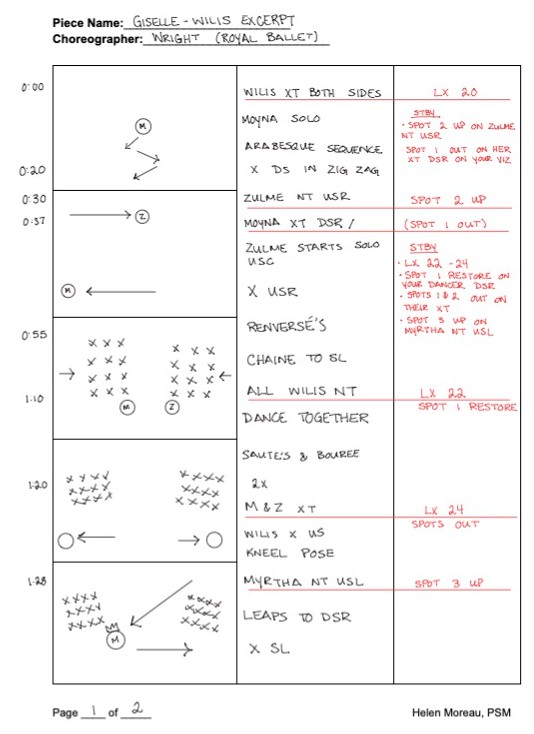
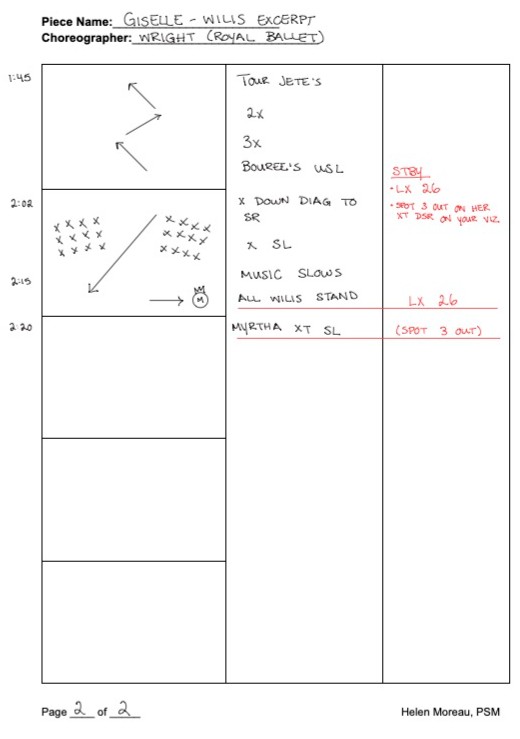
Dance tracking is a form of choreography notation using pictures and descriptive words. I like to format my dance tracking template into columns. The left side is diagrams of the stage, the middle is a written description of movement, and the right column is for cues. Some people prefer only diagrams, working from left to right.
When using this form of notation, you will need to establish a system to differentiate the dancers onstage. My notation method is that women are circles (because of tutus), men are triangles (because triangles are the strongest shape and male ballet dancers are very strong), and large groups are just X’s (because I can get lazy while drawing). When I’m feeling artsy, I will throw in a stick figure to show a specific pose. Although my method exists within the gender binary, yours doesn’t have to. Some people prefer X’s and O’s, and some use letters for dancer or character names. It doesn’t matter what you use, as long as it is consistent and/or notated like a legend on a map.
Much like the written format, it’s important to notate choreography at regular intervals. I like to have something notated for at least every ten seconds. This ends up being about one minute of dancing per page. Classical ballet pieces are notorious for not having many cues, so having frequent markers is useful to understand pace and for cues added during the tech or dress rehearsal process.
Pros and Cons of calling from dance tracking
Pros:
Creating dance tracking requires intimate knowledge of the choreography. Just like how rewriting your notes before a big test can help you study, putting pencil to paper, or Apple Pencil to iPad, creates a stronger memory of the choreography at hand.
Cons:
Creating this type of paperwork is time-consuming. Taking the time to draw out each movement may not be the most efficient use of your limited and precious time to prepare for a show.
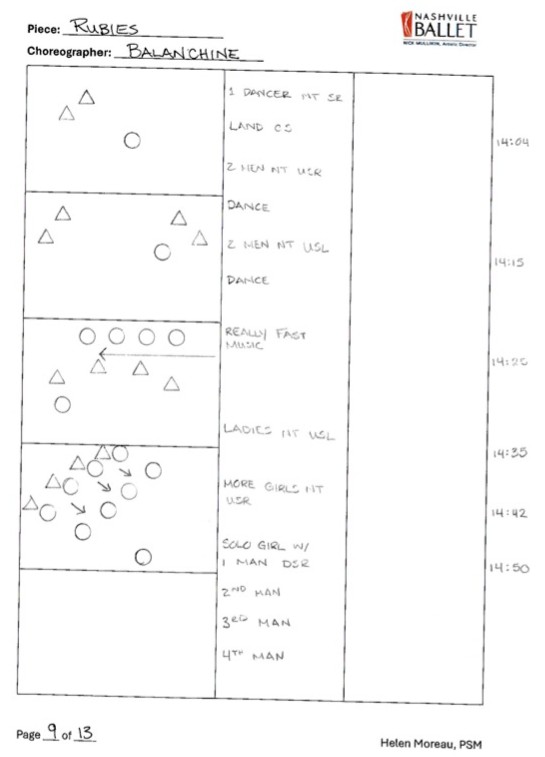
Rubies (George Balanchine. Choreography ⓒ The George Balanchine Trust)
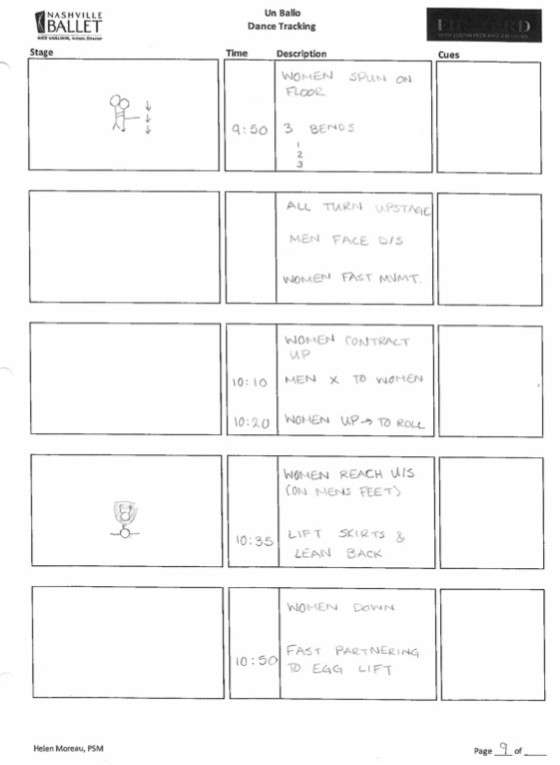
Un Ballo (Jiří Kylián Ⓒ)
Calling a Ballet from a Script
Sometimes dance performances do have words, a lot of them. I recently stage managed Sherlock, choreographed by Penny Saunders, set to audio from 1940’s and 50’s radio plays of Sherlock Holmes stories. Much of the movement was based upon the words being said. Because the script was so integral to the ballet, I chose to call it like a play or musical.
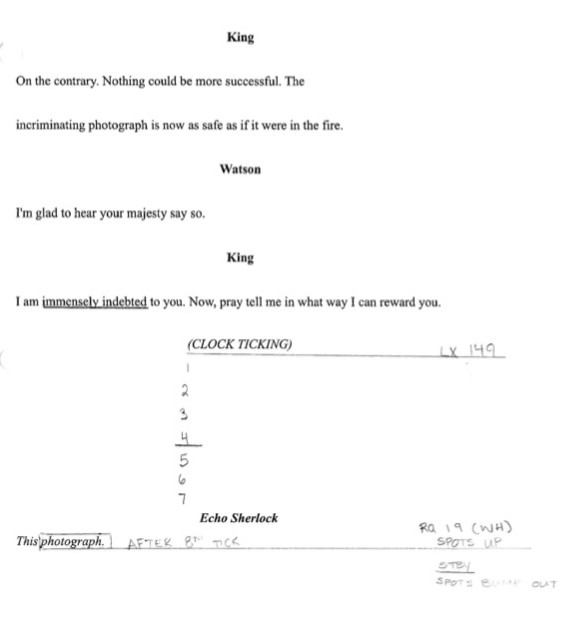
Sherlock (Penny Saunders)
Another outlier would be pieces set to popular music. In 2025, Nashville Ballet premiered a new work to the music of Elvis Presley called If I Can Dream. I called this piece from the lyrics, even though the movement wasn’t as integrated with the words as in Sherlock. I chose to do this because Sherlock was coming later that same season, and I wanted to prepare myself for something a bit more out of my wheelhouse. And the lyrics are readily available online. Being able to copy and paste the lyrics into a document and then edit as needed saved me a lot of time.
You will notice that there are counts during sections without lyrics. These were added to keep on track during the dance breaks. Meter is also important to notate in this call script. In the “Kiss Me Quick” section, there are numbers on the left-hand side of the lyrics, indicating how many counts each section is. In the following section, “It Hurts Me”, the meter changes to more of a waltz. I put notes in the margin that each line of lyrics is 4 counts of 6s. Although you can hear the music while calling, notating the meter can be helpful in making sure you are staying on track with any standbys and keeping up with the pace of the dancers.
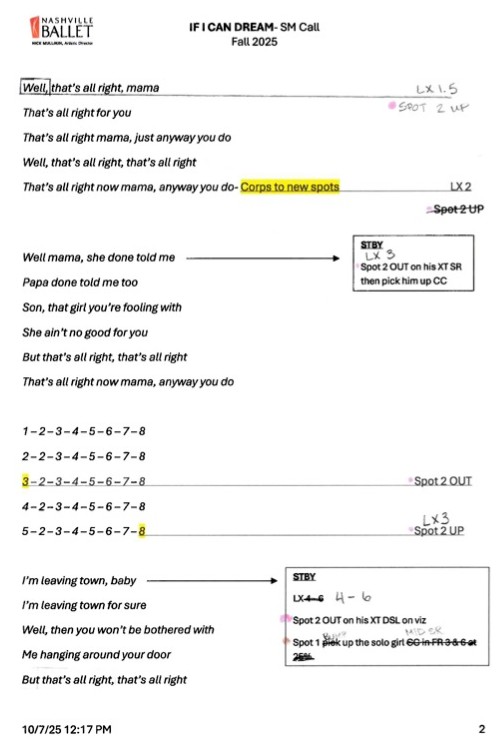
If I Can Dream (Travis Bradley)
Pros and Cons of calling from a script
Pros:
Starting with script or lyrics is an easy building block to create a prompt book because you don’t have to create the base of how you call.
Like using the score, if you and all the designers and choreographers are using the lyrics as a baseline, it is easy to communicate cue placement changes.
Cons:
You need to fill in the “blank” areas (parts of the piece that are only dance) with counts, dance notation, or written description.
This method is rarely able to be used when calling a dance show.
Combinations
Dance as an art form is fluid and so should your prompt book. It can be useful to integrate multiple types of notation into a prompt book based upon the needs of the piece. If there are moments of dialogue, integrate the script. If there is a musical break, turn to the score. Use what serves you and the production best.
Dear Charlie, a piece set on Nashville Ballet 2 this past season, utilized the monologue from Charlie Chaplin’s “The Dictator” during the first movement.
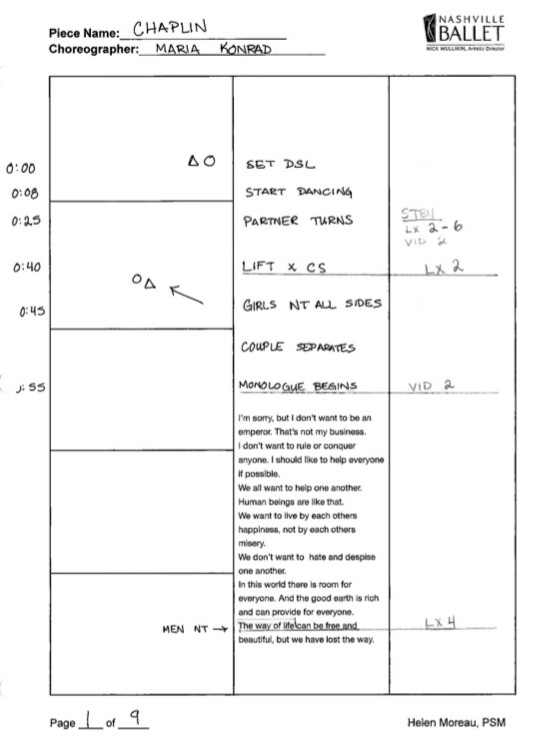
Dear Charlie (Maria A. Konrad)
I turn to the score during scene transitions. Counting along with the music gives an accurate countdown of the time remaining for the change and helps you stay on track with the pace of the performance. You can always go back to a different form of prompt when the change is complete.
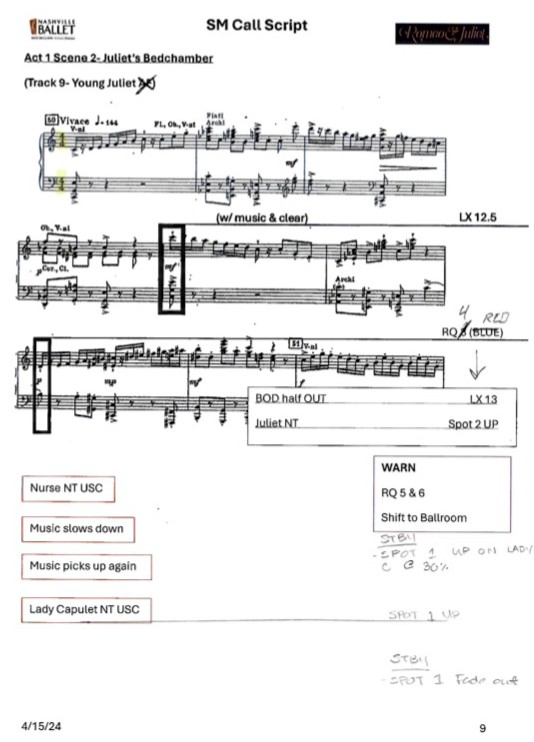
Romeo and Juliet (Paul Vasterling Ⓒ)
Compare and Contrast
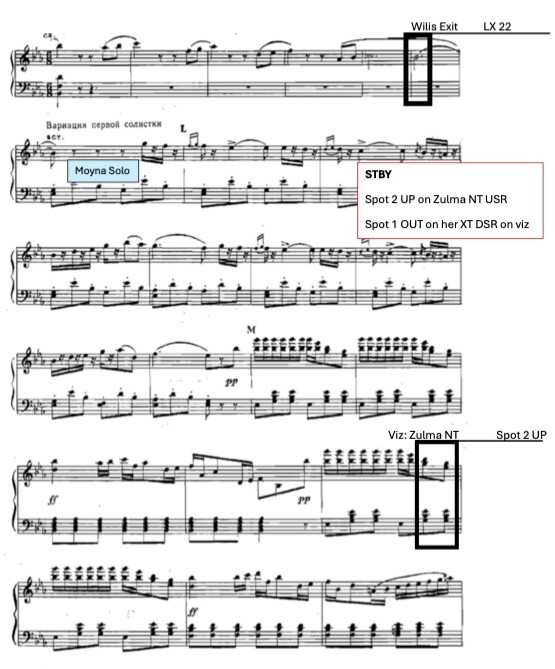
There is freedom to be creative when making a call script for a dance production. You can use what suits you best because you aren’t exclusively tied down to a script or score. Below you will find 3 different ways to notate the same excerpt from the Royal Ballet’s Giselle. What is different about them? What do you notice that is the same?
Score
Written Notation
Dance Tracking
Key Takeaways
- There is no single right prompt book for dance. Score, written notation, dance tracking, and script are all valid, so use whichever is clearest for you and for the piece in front of you, and combine them freely when it serves the show.
- Match the method to the material. Classical and remounted story ballets lend themselves to scores and written notation, text- or lyric-driven pieces call for a script, and brand-new choreography often needs dance tracking.
- Fill the blank space. Whatever format you choose, notate something at regular intervals (counts, meter, landmarks, can’t-miss movements) so the book gives you pace and context, not just a list of G-O’s. Otherwise you may as well be calling from the lighting designer’s cue sheet.
- Be consistent and legible, and flag your visuals. Symbols and shorthand only work if they’re used the same way every time and explained like a legend on a map, and cues called off a movement instead of a musical marker need to be marked as such.
- Build for the bus. The real test of a prompt book isn’t whether you can call from it, it’s whether someone else can. Fluency in multiple formats makes you a sharper show caller and a better substitute when it’s your turn to step in.
Photo courtesy of the author.

Editor's Note: At StageLync, an international platform for the performing arts, we celebrate the diversity of our writers' backgrounds. We recognize and support their choice to use either American or British English in their articles, respecting their individual preferences and origins. This policy allows us to embrace a wide range of linguistic expressions, enriching our content and reflecting the global nature of our community.
🎧 Join us on the StageLync Podcast for inspiring stories from the world of performing arts! Tune in to hear from the creative minds who bring magic to life, both onstage and behind the scenes. 🎙️ 👉 Listen now!
