Edinburgh Fringe in 4,232 Directions: Bodies Without Categories (Part 1)
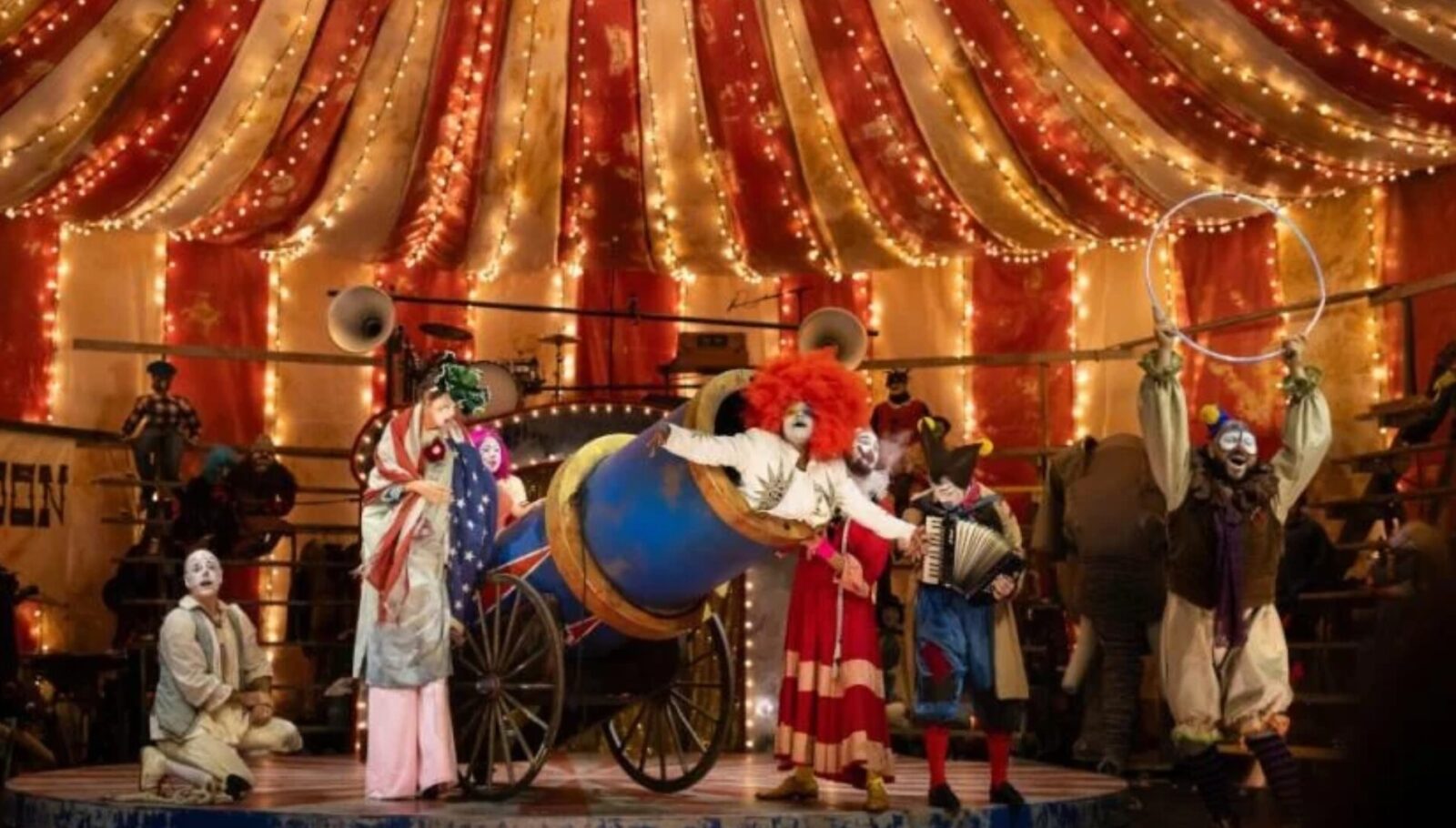
After near forty performances across the Fringe and EIF-Edinburgh International Festival, Raffaele De Ritis navigates 4,232 shows, increasingly unreliable categories — and finds the body almost everywhere.
Every July, in my hometown of Pescara on the Adriatic coast, I spend part of the month under a beach umbrella preparing for Edinburgh. This involves the Fringe programme, a notebook, a pen, and a system of hand-drawn boxes in which times, venues and possible combinations are made to intersect with impressive optimism. By late afternoon the pages can resemble the strategic plan for a minor military operation in Britain, prepared by somebody in swimming trunks.
It never survives Edinburgh.
The 2026 Fringe eventually contained 4,232 shows and 61,277 performances in 306 venues.
The printed programme resemble a telephone directory for a city that keeps adding streets. It was already several thousand shows thick before hundreds more arrived after it went to press. There is an official app, naturally, with maps, filters, a Nearby Now function and, when reason has finally failed, Shake to Search: shake your phone and it will choose a show at random. This may be the most intellectually honest piece of Fringe technology.
The titles themselves have learned to compete for survival. When Harry Met Sally Met Julie Met Jazz Met Kierkegaard Met Jung MetLovely JohnnyMarr managed to get seven cultural references into the door before the audience did. Man Sings the Same Song Over and Over Again for an Hour had the opposite virtue: it described the entire artistic proposition in eleven words. The man sang the song. For an hour. It subsequently won aBest Comedy Show award.
My first stroke of Edinburgh good fortune was not a five-star show but a bed. I was staying in an apartment graciously shared by the Italian team behind the Black Blues Brothers show, which in a city where accommodation has become one of the principal economic barriers for artists as much as audiences and industry is not a negligible detail.
The apartment had its own miniature Fringe. Alessandro Serena, producer,was usually already in motion — black polo, earphones, long stride — managing Edinburgh while the rest of his entertainment world continued in Italy. Nicola, quiet production manager, moonlights back home as a stand-up comedian and blogger; Federico, the technician, sometimes cooked. By breakfast, ticket sales, reviews and the shows seen the night before were already being picked apart over coffee.
Outside, meanwhile, Edinburgh acquires another skin in August. Posters spread over almost every vertical surface; successful ones soon acquire a second skin of their own, as reviews and stars are pasted over the original graphics.
Backstage has a habit of escaping into the street. A drag queen, temporarily relieved of half her plumage, eats beside a family studying its schedule as temporary food-and-drink villages swell into miniature Oktoberfests. Farther up the road, tourists make way for trolleys piled with costumes and sound gear. And yet, for all this promiscuous human traffic, intensive Fringe-going can be oddly solitary. Tables are occupied by individuals worked their phones like air-traffic controllers, calculating whether twelve minutes is enough to cross a city whose uphillmedieval street plan was not designed with a 3:45 p.m. cellar clown show in mind.
Then you enter a room, and the bodies begin to depend on one another.
Bodies Without Categories
The irony is that circus, dance and physical theatre represented only a small numerical fraction of the official Fringe programme. Yet physicality seemed to leak everywhere through the categories I was actually watching. The conclusion is therefore not that Edinburgh had suddenly become a circus festival. It is more troublesome than that: the programme categories were often less useful than the bodies inside them.
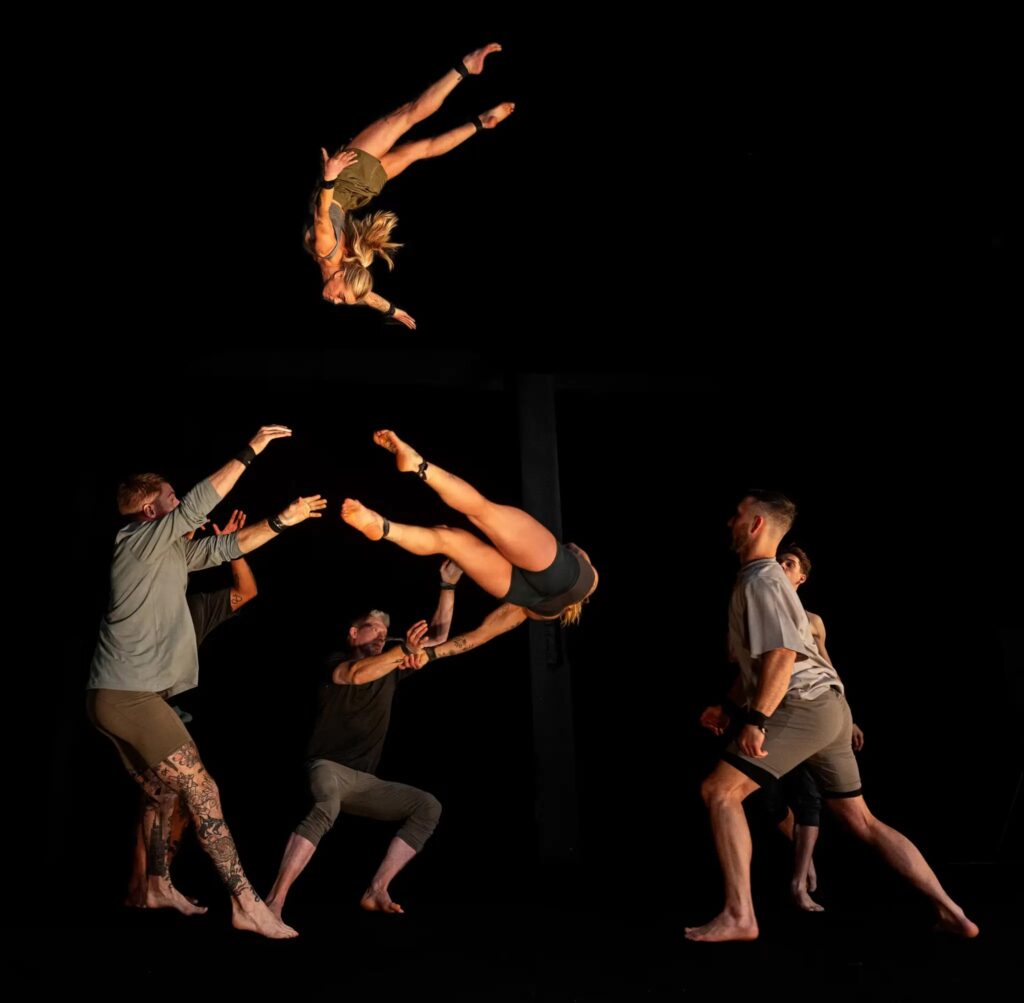
A good place to begin was Gravity & Other Myths’ Ten Thousand Hours. These are formidable acrobats; the technical level is never in question, and the Australian company has become an international touring force. Practice, error, rivalry, trust and assistance become the material of the show. The performers are not pretending to be fictional people with problems. They are acrobats with thousands of hours inside their bodies, and that proves to be dramaturgy enough. At its best, the ensemble works less like a sequence of circus acts than a chamber group in which gravity has been given the difficult part.
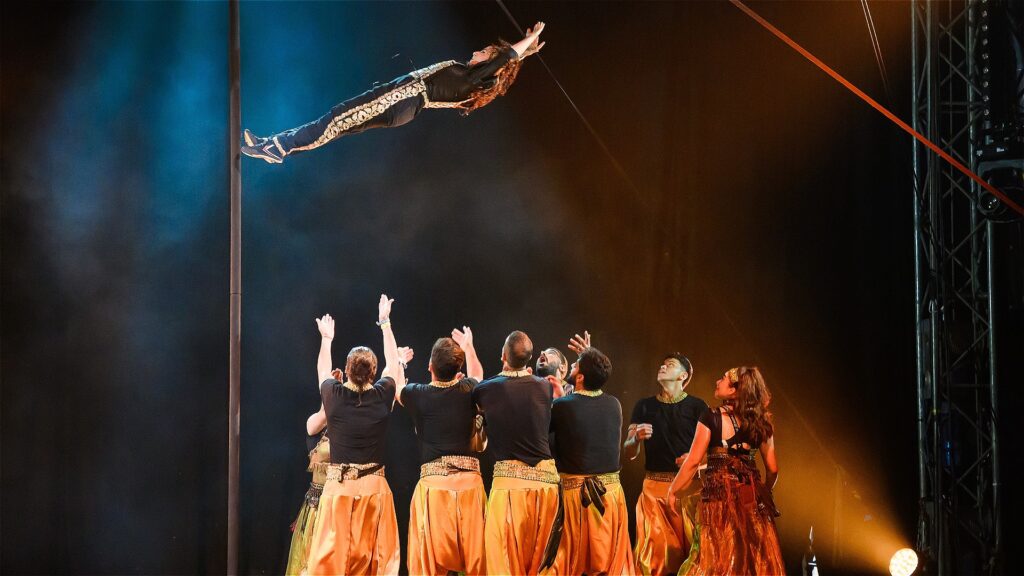
The Palestinian Circus’s Step and a Half turns the ensemble into something more politically charged. Its strongest statement was perhaps its most elementary circus fact: people support other people. They lift, fall, trust, recover. Given who these performers are and what surrounds their presence in Edinburgh, this can scarcely be politically neutral.The phrase used by one critic — “joy is a form of resistance” — was unusually difficult to improve upon.
They perform on thesame stage of WOLF by Circa, which I had seen before and which returned to the Fringe in 2026 with its cast of ten. I regard it as one of those rare contemporary circus works in which critical prestige and genuine audience seduction cease to be opposing ambitions. I have long thought of its director, Yaron Lifschitz, as the rare contemporary circus maker for whom acrobatics can become poetry without first having to apologise for being circus.
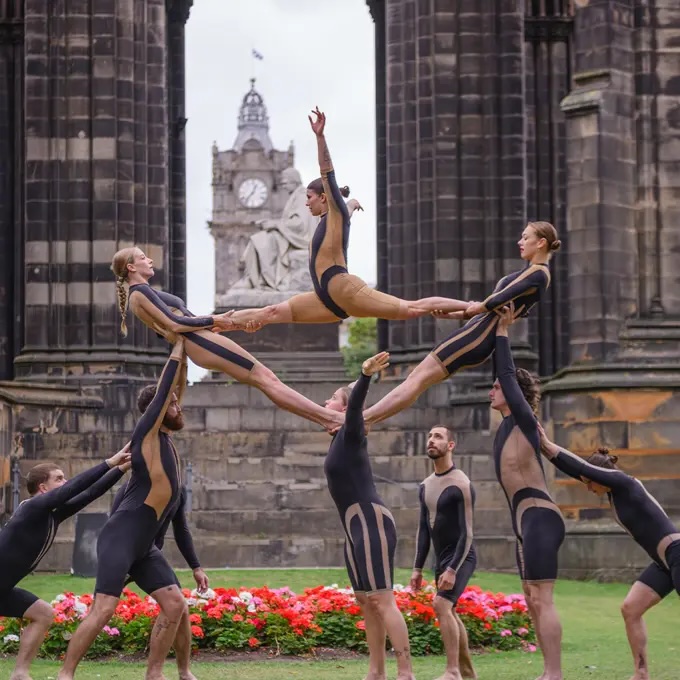
EXIT (by Belgian choreographer Piet Van Dycke and the company Circumstances)occupies another corner of the map: contemplative, repetitive in its mechanisms, fascinated by doors, walls, entrances, disappearances and collisions. Doors and walls behave like punctuation marks in a sentence that keeps rearranging itself, translating the mechanics of farce into acrobatic syntax. It reminded me of those art films at a large cinema festival which become absorbed in a formal question and then test how long that question can sustain our attention.
A whole zone of current circus seems to proceed this way. Rope in By a Thread, (byOne Fell Swoop Circus,billed as “Australian circus at his best”)ladders inThe Pieces, by Chicago-based Aloft,anaerial cradle in Collaborator(by British companyOckham’s Razor) glasses beneath the feet in Sweden’s OLOgroup’s Soft Spot, pole-dance in DUSK/NIGHT/DAWN by NYC collective Vertical Dreamscape;apparatus is no longer simply what allows the trick to happen; it aspires to determine the laws of the theatrical world. I did not see all these productions (somereceived withcritical success), and apparatus dramaturgy does not automatically mean successful dramaturgy. An object can generate thought. It can also remain an object with a very determined metaphor attached.
The real surprise came when the same physical logic escaped circus.
In Ben Norris’s The Distance, the performer tells his athlete story while running on a treadmill. The running is not decorative. It alters the breath, the timing, the voice and eventually the listener’s understanding of the text. Remove the physical ordeal and one does not merely remove a stage effect. One changes the play.
In Bigfoot Ripped My Dog in Half I Saw It, (one ofFringe’s most praised shows and withperhaps themost attracting title)Xhloe and Natasha deploy a precision of movement and vocal transformation verging at times on the acrobatic. They keep changing characters while a ridiculous piece of local misinformation grows into something socially uncontrollable. Rumour passes from body to body like an infection, while the writers-performerscouple operate the mechanism with the precision of two engineers who have built a machine they can no longer switch off. By the time the fake story has acquired a life of its own, clown andphysical technique (bordering at times hip-hop/breakdance flavour) has become a disturbingly accurate model of how reality gets manufactured.
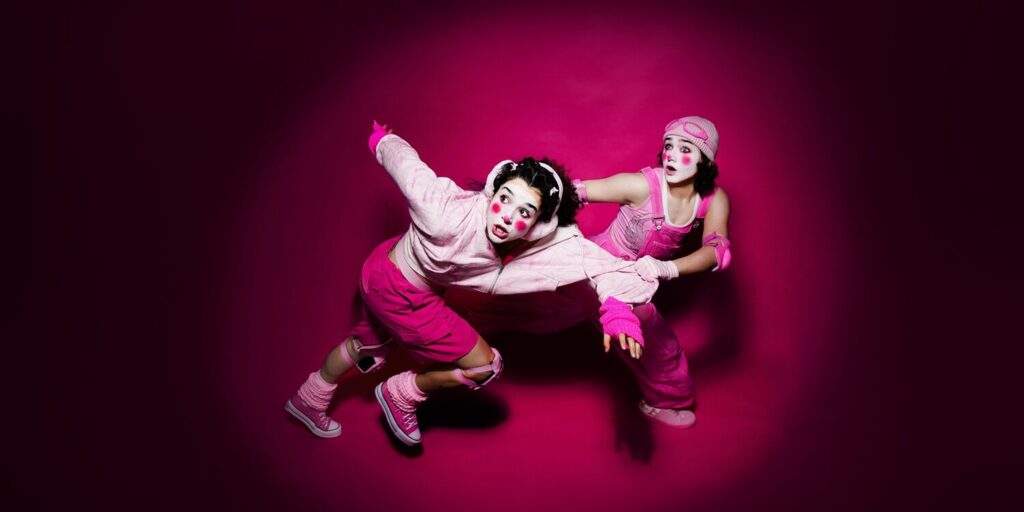
Hannah Reilly’s ROLEPLAY (she equally being brilliant as a writeras a performer)works through another kind of metamorphosis. Its route through sex work, public persona, attention and the economics of exposure is heavily dramaturgical, but it would scarcely survive on writing alone. Reilly has to keep physically generating the successive versions of herself that the story consumes. This is one of the places where “new writing” begins to sound like an inadequate description of what the actor is actually doing. The show’s unusually intense advance buzz and divided critical reception only added another layer to its subject: the performer is constructing a public identity while the Fringe simultaneously constructs one around the performer.
Frankie Thompson’s Horrible Things goes further into the borderland: lip-sync, clown, stand-up, found footage, facial distortion and performance art. At times her body seems to function as the last unstable screen on which the damaged debris of contemporary culture is still capable of being projected.
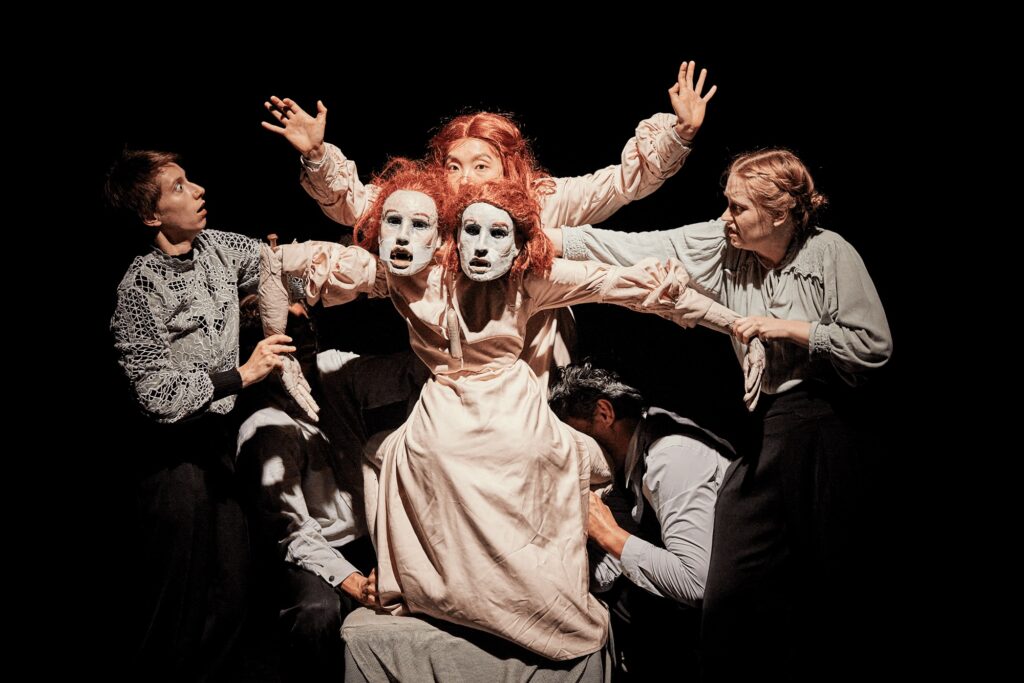
Two of the most persuasive reminders that novelty need not actually be new came from objects. In Thaddeus Phillips’s Around the World in 80 Toys, object theatre, live camera, miniatures and toys turn the stage into a tiny optical workshop, openly indebted to Méliès. Plexus Polaire’s Dracula: Lucy’s Dream works at a darker register: puppetry, black-theatre illusion and shifts of scale make it increasingly difficult to tell where the living body ends and the manufactured one begins. Both reach backwards — toward the old laboratory of nineteenth-century magic theatre and early cinema — to recover something oddly contemporary: theatre as a physical craft made from hands, light and things. At a festival perpetually hunting for what has never been done before, it was reassuring to discover that one route to originality is remembering what theatre once knew how to do.
Even my excursions away from physical performance failed to provide much escape.
One evening Alessandro and I went to hear Augustin Hadelich — aviolinist considered among the finest alive — with Kirill Petrenko and the Berliner Philharmoniker. The official festival programme had Beethoven and Scriabin in mind; I had the additional pleasure of briefly sitting still.
On another excursion I went to John Wilson and the Sinfonia of London’s The Golden Age of Hollywood. Gershwin, Cole Porter, Irving Berlin, Rodgers: music built to suggest the visual abundance of a cinema in which orchestras, colour, bodies, sets and impossible amounts of fabric were once expected to coexist. After days spent admiring what Fringe artists can construct from one chair, a rope and a funding problem, I found myself enjoying the remembered illusion of opulence.
Back at the apartment, Federico listened to these reports.
“Ah,” he said. “So you went to the real theatre.”
The phrase was excellent. The International Festival then refused to behave.
Mario Banushi’s TavernaMiresia is almost wordless: grief and memory are carried through bodies, food, objects, song, repetition and ritual. Physicality here has nothing to do with athletic ability. It is memory residing in action.
And Geoff Sobelle’s Clown Show was among the experiences I admired most in Edinburgh. Sobelle takes American circus and clown iconography — its optimism, violence, vulgarity, excess, resilience and appetite for disaster — and allows it to decay along with the country it is reflecting. The political allegory does not sit on top of the clowning. The clown mechanism itself — try, fail, repair, make matters worse — becomes the national mechanism.
By the end, the stage looks less like a circus than a fairground after somebody has cut the power. That final movement struck me especially. After the density of colour, gags and physical disorder, the stage ends up resembling the remains of a riot: bodies and objects after the appetite for chaos has exhausted itself. Something in that aftermath brought back, for me, the funereal melancholy of Fellini’s I Clowns. Not because Sobelle quotes Fellini, but because both understand that the circus image can become most disturbing when the noise has stopped. The silence after Clown Show felt more devastating because so much energy had apparently been spent producing a chaos that, finally, had nowhere left to go.
At the same EIF, Mere Mortals placed the San Francisco Ballet against electronics, digital imagery and the contemporary Pandora’s box of artificial intelligence. The institutional scale was utterly different from the Fringe basement; the artistic problem was not. Human bodies were once again attempting to define themselves against the systems built around them.
Federico’s “real theatre” was becoming difficult to locate.

A recognized historian, Raffaele has authored seminal books and papers in seven languages, teaching and lecturing worldwide. His circus history book Storia del Circo, in Italian, is considered the most extensive reference text on circus by most international historians. Raffaele is also one of the authors of the Circopedia project. He is the custodian of an extensive private circus collection, with pieces dating from the XVth century, and is seated on the Performing Arts Council of Italy’s Ministry of Culture. As well, Raffaele is a professor of Economy of Creative Industries at Unich University in Pescara (Italy) and of Art Direction at the Institute of Artistic Industries in the same city. www.raffaelederitis.com
Editor's Note: At StageLync, an international platform for the performing arts, we celebrate the diversity of our writers' backgrounds. We recognize and support their choice to use either American or British English in their articles, respecting their individual preferences and origins. This policy allows us to embrace a wide range of linguistic expressions, enriching our content and reflecting the global nature of our community.
🎧 Join us on the StageLync Podcast for inspiring stories from the world of performing arts! Tune in to hear from the creative minds who bring magic to life, both onstage and behind the scenes. 🎙️ 👉 Listen now!
