Inside Broadway’s Record Season and the Superfans Keeping It Afloat
For the second year in a row, Broadway posted another record-breaking year at the box office with $1.91 billion in revenue. And for an industry still catching its breath from the pandemic shutdowns, this is another welcome sign that Broadway is making a comeback. The thing is, though, by almost every other measure of activity, Broadway did less last season. The number of new shows that opened fell sharply. The total number of playing weeks for all shows shrank. And the most curious of all, attendance was slightly down from last year, and we still haven’t quite matched pre-pandemic levels.
So there’s actually not much to celebrate yet about this record-breaking revenue. However, that’s exactly what Broadway League President Jason Laks did in a recent statement: “Congratulations to the entire theatre community…Even in a challenging economic environment, Broadway remained notably on par with last season, reflecting both the resilience of this industry and the connection audiences feel to these productions.” But if you look even closer, you’ll see that Broadway’s record revenues are mostly made up of the same theatergoers buying tickets over and over and over again.
In fact, it was The Broadway League that conducted an audience survey for the 2024-25 season, and the demographics show that the average theatergoer attended 5.4 shows, compared to 4.7 in the prior season. Meanwhile, the truly eager theatergoers, who attended 15 or more shows, may have accounted for just 8% of the audience, but they bought 40% of all tickets. Being in the cast of Beetlejuice last year, I can certainly attest to the fact that we had people who loved the show and came back time and time again. But the numbers indicates that Broadway is likely losing the casual fans while doubling down on the obsessive ones, which are more than making up the difference, for now. That’s less a comeback and seems more like a step back, letting a smaller circle of people work harder to hold up the whole enterprise. And if you zoom out, it becomes evident that revenue and attendance growth have actually been diverging for decades.
Since 1980, Broadway’s total revenue has risen by 150%, when you account for inflation. Yet during that same stretch of 45 years, attendance rose by only 50%, meaning that Broadway’s box office has grown three times faster than its audience. In fact, the 1980-81 season was also a record-breaking time for Broadway, the culmination of eight years of sustained growth. However, the New York Times also reported at the time that ticket prices “continued to rise at a rate far above the inflation rate, and Broadway’s gross revenues have risen almost twice as fast as inflation in the last decade.” It was a boom that was built on popularity, as New Yorkers who’d never thought of themselves as theater people were showing up to see shows like A Chorus Line and Grease.
But then everything started to crater. In the first half of the 1980s, Broadway lost close to half of its audience. Even the shortened season after the Covid shutdowns had higher attendance than Broadway did in 1985. Now, it is true that Times Square in that era was genuinely a dangerous place to be, which did affect the appeal of going to midtown to see a show. But it is also true that fewer and fewer new shows were coming to Broadway. In that 1980-81 season, there were 64 new shows that opened, but ten years later that number was down to 29. And that steady decrease was showing up at the Tonys as well. In 1985, the nominating committee eliminated three categories entirely: Best Actress in a Musical, Best Actor in a Musical, and Best Choreography. And by 1995, things were still pretty bad as there were only two shows eligible for Best Musical, one was based on a movie (Sunset Boulevard) and the other was a revue (Smokey Joe’s Cafe).
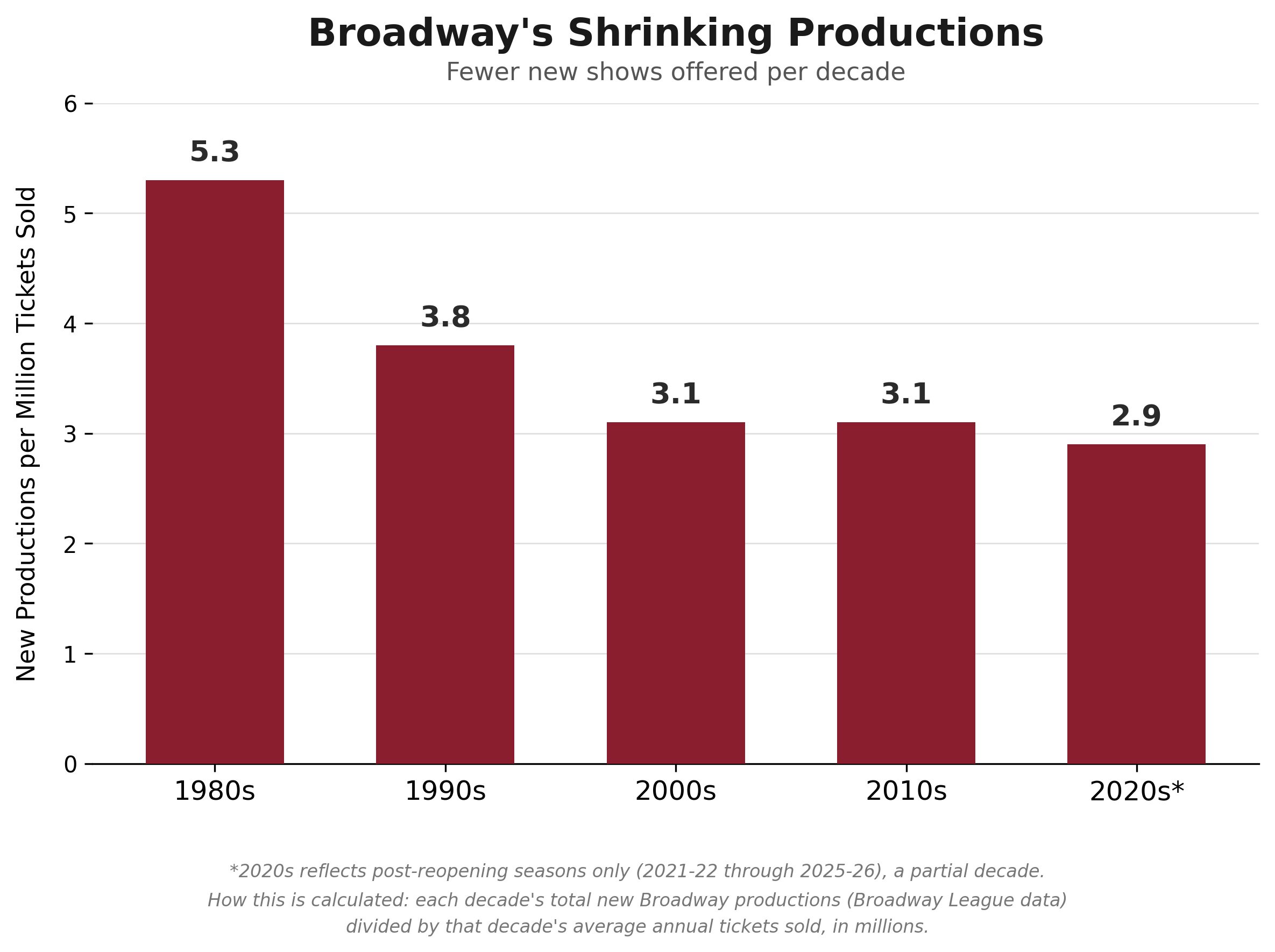
Ultimately, it took about 17 years for Broadway attendance to climb back to what it had been, and then between 1998 and 2014 attendance remained steady between 11.5-12.5 million. And these are the decades when revenues not only outpaced attendance but new shows being produced as well. The industry that once opened more than 50 new shows a year settled into a smaller, safer version of itself, and never really left it. With every decade, Broadway is steadily offering theatergoers less to see, leaving audiences with almost half as many new things to choose from per person as they did forty years ago. (See chart below.) And this past season is a perfect example. That dip in attendance was entirely due to fewer people going to see musicals, even as more people saw plays. It didn’t help that there were just 6 new and original musicals to choose from (two of which closed within 6 weeks of opening).
None of this means that Broadway is dying, though, and anyone writing that headline right now is getting ahead of the data. However, the concern is real because Broadway audiences have been shrinking, even as New York City tourism was growing. Despite a jump in city visitors of roughly 190% from the early 1990s to its peak in 2019, Broadway attendance only went up about 102%. To put it plainly, while the number of NYC tourists nearly tripled, Broadway’s attendance only doubled, meaning the tourist economy was growing far faster than the industry’s ability to capture it. But there is some good news since the reopening in 2021: Broadway has been able to keep pace with tourism’s own recovery. Only time will tell if this short-term trend will continue.
Until then, looking back in theater history could offer some answers for today. The 1920s represent the high point of Broadway production, when it was neither contracting nor confined. There were something close to 80 working theaters, almost double what exists today, spilling out well beyond the current Theater District limits. For instance, Shuffle Along, the landmark all-Black musical that reshaped what Broadway music and dance could be, opened in 1921 at a theater far outside the modern district’s boundaries and wouldn’t even qualify as “Broadway” by today’s map. And with more theaters also came more shows, which opened constantly and would sometimes close just as fast. Back then, Broadway was a high-volume business. During that decade, nearly 2,500 productions were staged, with attendance peaking in the 1927-28 season that led to a reported 12 million tickets sold. It would take Broadway 78 years before it would see attendance numbers like that again.
Back then, a producer could mount a show on a shoestring, and if it flopped, there was another one opening down the block next week. It was a much larger, much cheaper, much more experimental industry than it is today. A hundred-performance run wasn’t a disappointment back then. It was a solid showing. Compare that to now, when a modern musical would have to run for years just to break even, and the vast majority never do. But this decline in new productions over the past 100 years didn’t happen because the appetite for theater disappeared. It happened as the cost of putting up a show onstage changed what a producer is willing to make.
“The painful truth is that, with things as they are, bringing almost any new show to Broadway makes little financial sense,” says composer and producer Andrew Lloyd Webber. And looking at the recoupment numbers, there is good reason for his concern. Since the reopening six years ago, only 9% of musicals have turned a profit during their production runs. Webber’s own Cats: The Jellicle Ball was one of the many that closed early and at a loss, so he has spoken out and called on theater owners, unions and producers to come together urgently to find a solution. And as I’ve shown, the answer isn’t to simply rely on charging more to the same pool of devoted theatergoers. Broadway has to take steps to get more people coming through the doors, and that means giving them more reasons to come in the first place. And no, I’m not talking about producing 250 shows a season like in the 1920s. But that attitude of lean and mean productions offers an insight into the kind of shows that could work.
Right now, the industry is choosing certainty over discovery at almost every turn. According to Broadway producer Jim Kierstead: “There’s greater emphasis on recognizable titles, built-in audiences, limited runs, strategic casting, and productions that can generate additional life beyond Broadway.” That instinct is understandable, because a familiar title is a safer bet than an unknown one, but then you’ve stopped giving anyone new a reason to come to the theater. But if there was a concerted effort to make room for smaller, more intimate productions that are fresh and original, it reduces the need for big casts or elaborate designs to make a revival or movie adaptation feel fresh on the stage. Shows like Kimberly Akimbo only cost a paltry $7 million to produce, and it went on to win Tony Awards for Best Musical as well as Best Book and Score. Now, it may have taken more than 3 years to recoup that investment, but it still shows that small productions can be both artistically and financially viable.
Once Broadway has something fresher to sell, the next move is local, not global. More than half of a show’s audience in the first four months comes from NYC and its suburbs. However, in 2024-25 less than 13% of ticket sales were from the NYC suburbs, the lowest percentage in thirty years. So Broadway has to get them back, because they’re the difference between a hit that tourists eventually hear about and a show that closes before anyone outside the five boroughs knows it existed. And Broadway actually has a working model to address this issue. The Theatre Development Fund already subsidizes access for students, teachers, and working artists, treating them not as a discount market but as an investment in the theatergoers Broadway will need a decade from now. There’s no reason that same logic couldn’t extend to New Yorkers more broadly, not as a handout, but as audience development: a first-time local theatergoer today is a repeat visitor tomorrow, and eventually the kind of person who brings three friends to see the latest show.
And once that local foundation is steadier, then it makes sense to chase after those NYC visitors, because the longer a show runs, the more its audience skews toward tourists. So we need to give them a compelling enough reason to choose a Wednesday matinee over anything else New York has to offer. And while most producers rely on celebrities, long-term sustainable success will only be possible by offering something they can’t see anywhere else, rather than a familiar face they could just as easily catch on a screen back home. Let the show be the star, rather than the name on the marquee. Six proved it’s possible without big-name actors in the cast. They built a devoted following around the US through regional tours, but also internationally through its various cruise ship productions. So by the time they reached Broadway, there was buzz and hype around the show and its songs and performances. A famous name can certainly sell a ticket. But it can’t make someone tell their friends back home they have to come see it too. Only the show can do that. I think Webber speaks for all of us when he says, “I am still in love with Broadway as I was as a teenager. I want future generations to experience that same sense of possibility.”
The big question remains whether any of this will be seen as urgent, while the box office looks this good, or if the record-breaking headlines will have to stop before Broadway realizes that its audience matters more than its revenue. And as an actor, I can tell you, nothing matters more than the audience. Giving them everything we can onstage, all while fostering a new generation of theater lovers, is what keeps us going. But if the focus stays on the money, then the industry as a whole will be too busy worrying about the ticket price, instead of the ticket buyer.
Main image: Photo by Canva

Editor's Note: At StageLync, an international platform for the performing arts, we celebrate the diversity of our writers' backgrounds. We recognize and support their choice to use either American or British English in their articles, respecting their individual preferences and origins. This policy allows us to embrace a wide range of linguistic expressions, enriching our content and reflecting the global nature of our community.
🎧 Join us on the StageLync Podcast for inspiring stories from the world of performing arts! Tune in to hear from the creative minds who bring magic to life, both onstage and behind the scenes. 🎙️ 👉 Listen now!
