Big Church Festival – The Emergency Is Over. Now What?
On Friday 28 August, Big Church Festival was underway at Wiston Estate in West Sussex when a large sign fell at approximately 3.38pm. A 41-year-old man died at the scene and other people were injured. Sussex Police subsequently confirmed that five other people were assessed and treated at the scene, with four taken to hospital, including two with more serious injuries.
The investigation into what happened is ongoing. Sussex Police are gathering evidence to support a joint investigation with Horsham District Council, and the Health and Safety Executive has also been informed. I am therefore not going to speculate about why the sign fell, whether it was adequately designed, what the weather was doing, who installed it or who was responsible for it. Those questions belong with the investigation and the evidence that eventually comes from it.
What I do want to talk about is how Big Church Festival has handled its communications afterwards, because during an absolutely terrible situation they have provided a very good real-world example of something I regularly talk about with event teams when I undertake emergency and risk management training.
We understandably spend a lot of time planning what happens during an emergency. Who makes the call to stop the event? Who contacts the emergency services? Who meets them when they arrive? Who communicates with the crowd? Who makes decisions about evacuation or shelter? Who has the authority to close the event altogether?
But when I work through emergency scenarios with teams, I also ask them to keep going. The immediate emergency has been dealt with, so what happens now? Who communicates with everyone afterwards? Who has the authority to say something publicly? And importantly, who is actually going to sit down and do it?
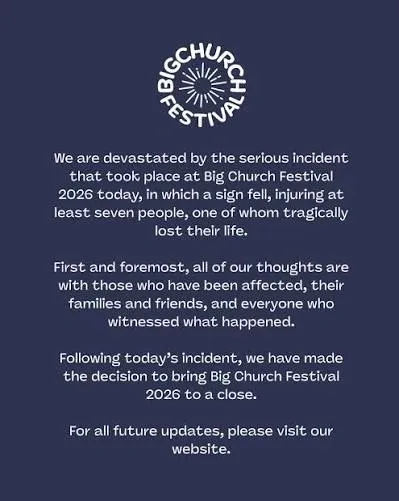
Following the incident, Big Church Festival initially paused the event before subsequently making the decision to close the festival completely. Its public statement was relatively short and careful. It acknowledged those affected, confirmed that it was working with the emergency services and relevant authorities, and explained that further information would be provided when it became available.
Alongside that statement, the organisers turned their website into a central source of information and created a dedicated Latest Updates page dealing with the practical questions people were understandably asking. Was the festival continuing? Where would updates be published? What was happening with refunds? What should people do if they had left belongings onsite? What should volunteers and partners do? Where should photographs or videos that could assist the police investigation be sent? Who should the media contact?
Rather than trying to put everything into one enormous statement, they have answered those questions individually and updated the page as more information has become available. Where they do not yet have an answer, they have said so.
The refund question is a good example. People understandably want to know what is happening with their tickets, but at the time of writing the organisers do not appear to have a final answer they can provide. Instead, they have acknowledged the question and explained that ticket holders will be contacted when further information becomes available.
There is nothing wrong with saying you do not know yet when you genuinely do not know. During an incident, it can be considerably better than rushing out information that subsequently needs to be corrected. Acknowledge the question, provide whatever information is confirmed and tell people how further information will be provided.
This is why, during training, I ask teams to think beyond simply putting “communications” into an emergency plan. I want to know who is actually going to do it.
If somebody was seriously injured or killed at your event this afternoon, who can update your website tonight? Who has the login details? Who has the authority to approve the wording? If that person is unavailable, who else can do it?
Then we start thinking about everything that was already running before the incident happened. Is there a cheerful social media post scheduled to automatically appear at 6pm? Is an email campaign going out tomorrow morning promoting next year’s event? Are tickets still being sold? Who knows those systems are running and who has the access and authority to stop them?
There are also far more people to communicate with than we sometimes appreciate when writing an emergency plan. There are the people directly involved and their families, other attendees, staff, volunteers, contractors, suppliers and partners. There may be people trying to recover belongings, ticket holders wanting information about refunds and journalists looking for a statement. There may also be witnesses with photographs or videos that investigators need.
All of this can be happening while the event team themselves are exhausted, distressed and dealing with police, emergency services, regulators, insurers, venue management and the operational consequences of what has happened.
That is why these responsibilities need to be worked out beforehand. Saying “the communications team will manage it” is easy when we are sitting around a table writing an emergency plan. At 9pm on a Saturday night, I want to know who that person actually is, whether they know it is their responsibility and whether they have what they need to do it.
There is also the question of what can be said. Somebody needs to be liaising with the police, regulator or other investigating authority about information that can be released publicly. Communicating quickly is important, but so is protecting an investigation, respecting the privacy of the people involved and making sure the information being published is correct.
The way Big Church Festival has used its website is particularly useful because it provides one authoritative place for people to go. Social media can direct people towards it, but following a serious incident social media can become chaotic very quickly. Old posts continue circulating, screenshots lose their context, comments become mixed with rumours and speculation, and information that was correct several hours earlier may no longer reflect the current situation.
A central webpage gives the organiser somewhere to maintain the current information and somewhere that social media posts, emails, media responses and other communications can point people towards.
None of this changes the importance of preventing an incident in the first place. We still need appropriate design, engineering, installation, inspection, monitoring and risk controls. The investigation into what happened at Big Church Festival needs to run its course, and there may eventually be important lessons for the events industry from its findings.
But we do not need to know why the sign fell to recognise something the organisers appear to be doing well during an extraordinarily difficult situation.
They have created a clear place for information, answered the practical questions they can, directed potential evidence to the police and provided information for the different groups involved with the festival. Where an answer is not yet available, they have acknowledged that rather than trying to provide one prematurely.
It is a very good real-world example to put in front of an event team when we are talking about what happens after an emergency: if this was us tonight, who would actually do all of this?
This article is based on publicly available information at the time of writing. The circumstances surrounding the incident at Big Church Festival remain under investigation, and no conclusions are being drawn here about the cause of the incident, the adequacy of any structures or controls, or the responsibility of any individual or organisation involved. The purpose of this article is solely to consider the communication and incident management response following the event and what other event teams may wish to consider within their own emergency planning. Information may change as the investigation progresses.
This article was originally published on Bespoke.
Photo sourced in Canva
Originally from Manchester in the United Kingdom, Bea has spent more than 25 years working across the events industry in both the UK and Australia. Her career started in event operations and production, working on conferences, exhibitions, festivals, fashion events and major public gatherings before moving into safety and risk management. Along the way she worked with venues including Earls Court and Olympia in London, NEC in Birmingham and supported events ranging from art fairs and exhibitions through to large public festivals and community events.
After moving to Australia in 2004, Bea established herself as one of the country's most recognised event safety professionals, working with event organisers, councils, venues, suppliers and government agencies to help deliver safer and more resilient events.
Known for describing herself as the industry's professional Devil's Advocate, Bea is recognised for asking the difficult questions early, challenging assumptions and helping clients identify issues before they become problems. Her approach combines practical operational experience with formal safety qualifications, allowing her to bridge the gap that can sometimes exist between compliance requirements and the realities of delivering live events.
Through her writing and speaking, Bea explores the lessons that can be learned from incidents, disasters, popular culture and everyday experiences, making complex safety conversations accessible, practical and relevant for the wider events industry.
Editor's Note: At StageLync, an international platform for the performing arts, we celebrate the diversity of our writers' backgrounds. We recognize and support their choice to use either American or British English in their articles, respecting their individual preferences and origins. This policy allows us to embrace a wide range of linguistic expressions, enriching our content and reflecting the global nature of our community.
🎧 Join us on the StageLync Podcast for inspiring stories from the world of performing arts! Tune in to hear from the creative minds who bring magic to life, both onstage and behind the scenes. 🎙️ 👉 Listen now!