Martin Frenette: Politically in Circus
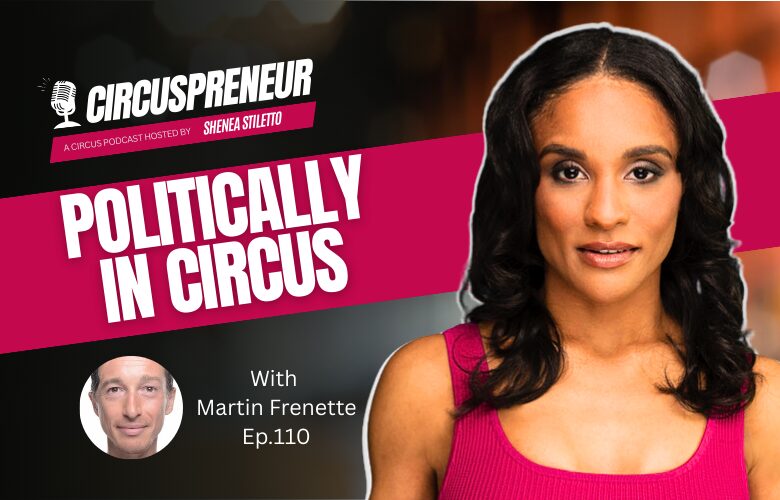
In this episode of the Circuspreneur Podcast, we’re getting real about politics… from the perspective of circus artists. Host Shenea Stilettto is sitting down with her friend and fellow circus professional Martin Frenette, and together they’re talking about what it’s like to navigate today’s political climate—not as analysts or policy makers—but as performers and creatives who live it from the ground up.
What happens when circus artists step into civic and political spaces?
Martin Frenette:
When circus artists enter civic and political spaces, the conversation changes—often immediately. Both host Shanice Saleto and guest Martin Frenette describe how artists bring a lived, embodied understanding of collaboration, crisis management, and adaptability that is largely absent in traditional policy environments. Circus artists are used to navigating uncertainty, solving problems in real time, and working across borders, cultures, and languages. These skills translate powerfully into civic engagement.
Rather than being passive observers of political systems, circus artists have the capacity to be interpreters of complex issues. Their lived experience of touring internationally, working under precarious conditions, and engaging with diverse communities gives them an informed, global perspective. When policymakers encounter circus artists, they are often surprised by their depth, eloquence, and strategic thinking—challenging the reductive stereotype of circus as mere spectacle or entertainment.
Ultimately, stepping into civic spaces allows circus artists to advocate not just for their sector, but for broader human-centered approaches to governance, policy, and representation.
How does movement become a political message?
Martin Frenette:
Movement becomes political when the body itself becomes a form of testimony. Both speakers reflect on the irony—and power—of consuming political news while physically inverted, juggling, or training. Circus artists literally see the world from different angles, and that perspective shapes how they interpret power, conflict, and responsibility.
Martin points out that just as late-night television hosts translate hard news into accessible commentary, artists translate complex realities through embodiment and storytelling. Circus, by its nature, communicates resilience, risk, trust, and interdependence—values that are deeply political even when they are not explicitly framed as such.
Shanice adds that her presence in political spaces often disrupts expectations. The language she uses, informed by artistic practice, introduces metaphors and frameworks that policymakers are not accustomed to hearing. This reframing invites deeper reflection and opens doors to conversations that might not otherwise happen. In this way, movement is not separate from message—it is the message.
Why are circus artists often underestimated in policy and funding conversations?
Martin Frenette:
Circus artists are frequently underestimated because their expertise does not fit neatly into conventional academic or bureaucratic frameworks. Martin highlights how circus professionals are often asked where their “degree” is, despite decades of professional experience. This bias overlooks the reality that circus artists must constantly research, communicate, negotiate, and articulate value—skills that mirror, and often exceed, those required in formal institutional settings.
Grant systems and cultural agencies have historically privileged traditional credentials, even though many circus artists possess deep practical knowledge, leadership experience, and philosophical insight. Shanice notes that circus artists are constantly justifying their existence: their training, their legitimacy, their economic value. This ongoing defense builds sharp communicators and strategic thinkers, even if that labor is rarely acknowledged.
The irony, both agree, is that circus artists are uniquely prepared for civic problem-solving because they are trained to make things work under pressure, without backup, and with real consequences.
What does the circus industry teach us about leadership and crisis response?
Martin Frenette:
Circus culture operates on the principle that “the show must go on,” not as a cliché, but as a survival skill. When something goes wrong, there are often no understudies, no replacements, and no time for extended deliberation. Artists must adapt instantly, redistribute roles, and find solutions that protect both the work and the people involved.
Martin describes this as having “emergency response in the blood.” Circus artists are conditioned to assess risk, communicate clearly, and act decisively—qualities that are invaluable in governance and public service. Shanice adds that this level of responsibility fosters a deep sense of ownership and accountability, traits that are often missing in top-down decision-making structures.
This hands-on mentality makes circus professionals natural leaders. If excluded from policy conversations, the industry risks having its future defined by people who do not understand its realities.
Why is it essential for circus artists to claim a seat at the table now?
Martin Frenette:
Both speakers emphasize that if an industry does not help define its own future, someone else will do it for them. Today’s generation of circus artists is no longer satisfied with marginal inclusion or symbolic recognition. They are seeking real representation in the rooms where laws, funding structures, and cultural priorities are determined.
Circus artists are already deeply engaged in global conversations—often informally, through touring, collaboration, and community-building. Formalizing that engagement through civic participation is the next step. Representation ensures that policies affecting labor, mobility, safety, and cultural value reflect lived experience rather than assumptions.
In short, circus artists belong at the table not despite being artists, but because of it. Their ability to balance risk, creativity, discipline, and humanity offers a vital perspective in an increasingly unstable world.
Key Takeaways
Circus artists bring real-world problem-solving, adaptability, and crisis leadership into civic and political spaces.
Movement and embodiment offer a powerful alternative language for political engagement and storytelling.
Circus professionals are often underestimated, despite being highly skilled communicators, strategists, and negotiators.
The “show must go on” mindset creates leaders who are decisive, collaborative, and solution-oriented.
Circus artists are no longer asking for visibility—they are claiming a seat at the decision-making table.
If the circus industry doesn’t help define its future, others will define it for them
Listen to this Episode on:
Spotify / Apple Podcasts / YouTube
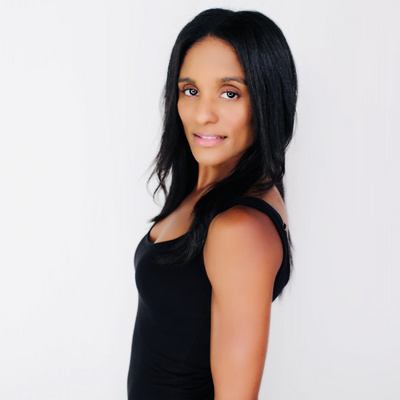
Shenea was also a finalist on America’s Got Talent and has continued to be a featured artist with prominent circus entertainment companies worldwide.
Editor's Note: At StageLync, an international platform for the performing arts, we celebrate the diversity of our writers' backgrounds. We recognize and support their choice to use either American or British English in their articles, respecting their individual preferences and origins. This policy allows us to embrace a wide range of linguistic expressions, enriching our content and reflecting the global nature of our community.
🎧 Join us on the StageLync Podcast for inspiring stories from the world of performing arts! Tune in to hear from the creative minds who bring magic to life, both onstage and behind the scenes. 🎙️ 👉 Listen now!
